Central – Chater Garden ca.1940
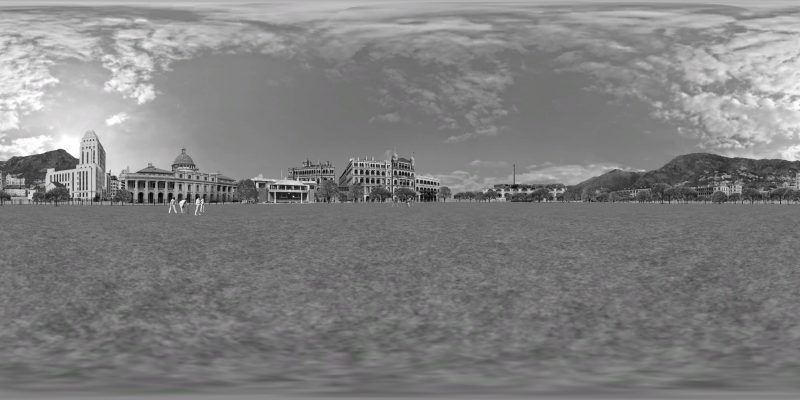
360-degree panoramic artwork developed from historical photos
Historical Hotspots:
Butterfield & Swire Co. Building
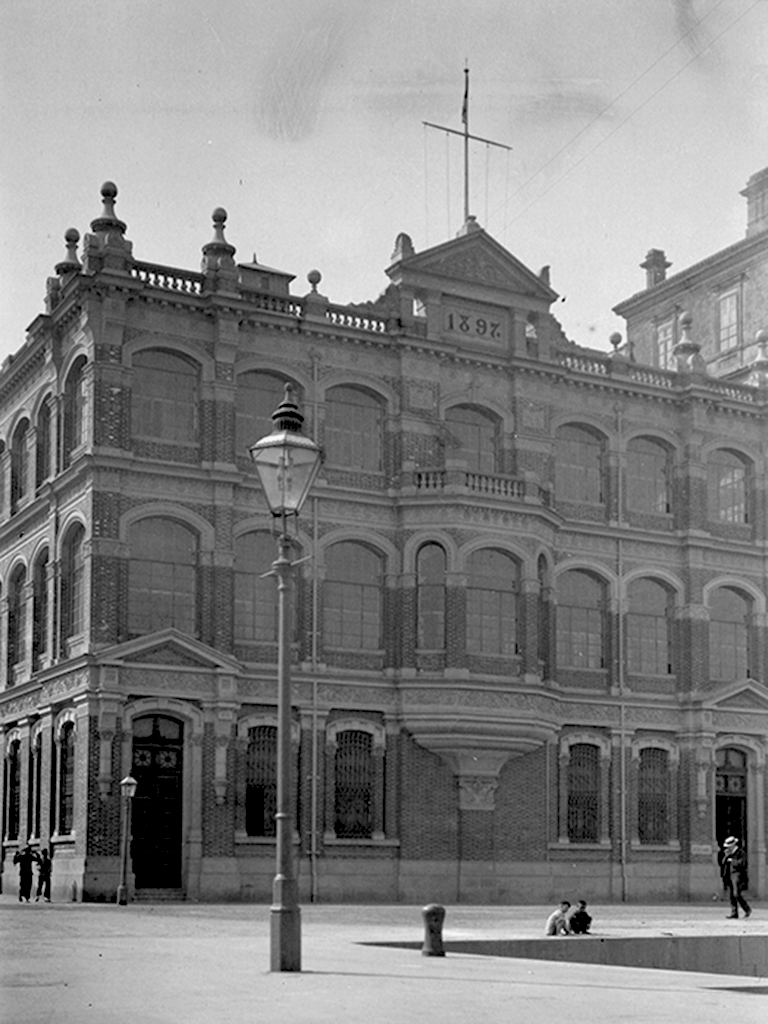
Butterfield & Swire was originated in 1816 by John Swire for his import and export businesses in Liverpool, the United Kingdom and was established by his son in 1866, Shanghai. In 1870, Butterfield & Swire expanded its business to Hong Kong and auctioned a site in Central in 1895. The location, with its proximity to the sea, was convenient for transporting of goods and setting up offices. The branch office of Butterfield & Swire, located at No.1 Connaught Road, was completed in 1897 and designed with red bricks in a Renaissance style. In 1973, the original building site was merged with the New Oriental Building site and developed into the Furama Hotel.
The Chinese name ‘Taikoo’ of Butterfield & Swire has the meaning of “Great and Ancient”. In the early stage of Hong Kong’s business development, Butterfield & Swire mainly acted as an agent of shipping companies for passengers and freight business. Later, the Taikoo Sugar Refinery and Taikoo Dockyard were built in Quarry Bay. At the same time, the shipyard served as a reliable local repair facility for the Blue Funnel, China Navigation and Taikoo Sugar Refinery’s fleets. It also took care of the maintenance of British naval ships in Hong Kong and shipbuilding projects in southern China. Swire’s business became more diversified after World War II, including trading, painting, aviation, soft drink and so forth. The Sugar Refinery site was turned into Taikoo Trading Estate (now Taikoo Place), whereas the Dockyard was also reconstructed as ‘Taikoo Shing’, a private residential area. The business of Swire became closely related to the daily lives of people in Hong Kong.
Photograph by G. Warren Swire
Photo courtesy of John Swire & Sons Ltd and Historical Photographs of China, University of Bristol
New Oriental Building
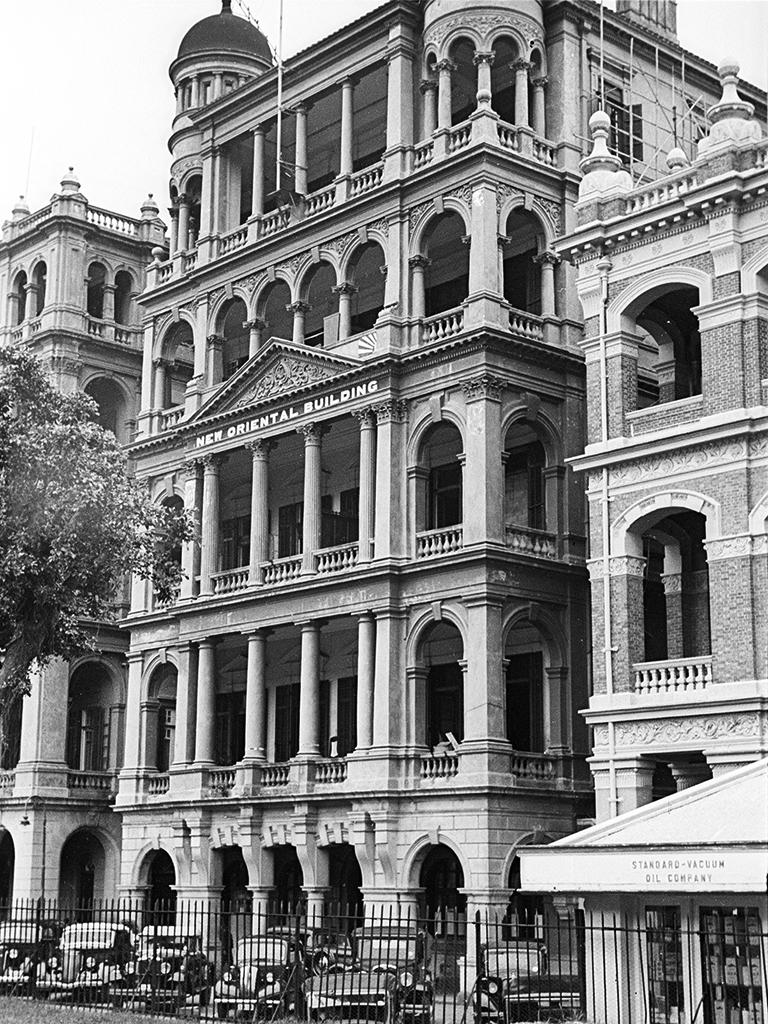
Designed by Palmer & Turner (P&T Group) in typical Victorian Indo-Saracenic style, the New Oriental Building was launched in 1898. The building was used as the headquarters of the Hong Kong Police Force after World War II. In 1954, the Force moved out and the building was demolished at the end of the year.
After the demolition of the New Oriental Building, the owner had planned to merge it with the Butterfield & Swire Building and rebuild it into a hotel. However, the Mercury House nearby, which was the headquarters of Cable & Wireless, owned sensitive and precise instruments that would be negatively affected by the piling works. The reconstruction was delayed while the floor plans were modified more than 30 times. In 1972, while Cable & Wireless was relocated to Wan Chai, the Furama Hotel could finally be constructed. The hotel was completed in 1973, and its top floor became the first revolving restaurant in Hong Kong.
Photo courtesy of the American Geographical Society Library, University of Wisconsin- Milwaukee Libraries
The Hong Kong Club
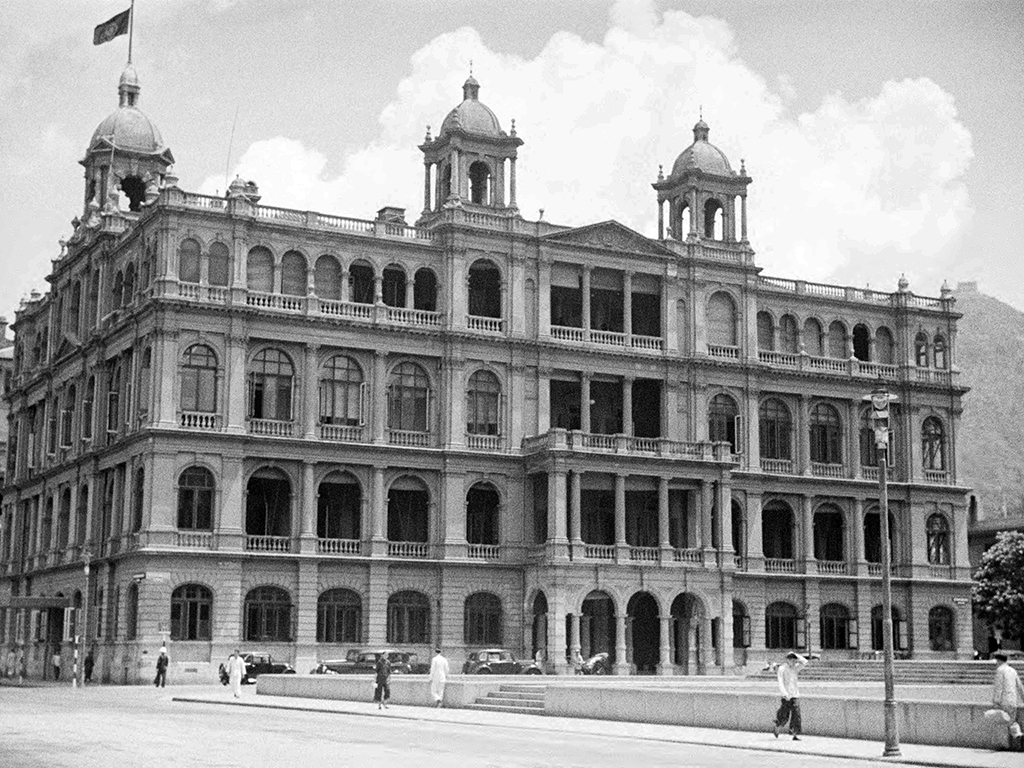
The Hong Kong Club made successful bids on the land in 1895, and the clubhouse was launched two years later. The Hong Kong Club was an association for foreigners (especially the British members) to gather for social and entertainment purposes in Hong Kong, as well as providing high-end catering and business services to senior government officials, senior local businessmen and celebrities. The Victorian-style clubhouse was four-storey high, with a stone arched hall at the front entrance, a terrace on top and towers on both sides. In 1899, the rear building of the clubhouse was also completed, and it was connected to the front of the building by a flyover on the second floor.
The Hong Kong Club was established in 1846 by eight British businessmen residing in Hong Kong. Although it is called “The Hong Kong Club”, it was not open to everyone because membership qualifications were limited to European citizens only. In the mid-1960s, the association began accepting Chinese members and opened its door to women since 1996. The clubhouse was once a prominent communication centre in terms of politics and commerce. To preserve the building, members objected to the reconstruction plan of the building three times, the general public also initiated campaigns to protect it. In 1981, the clubhouse was eventually rebuilt due to the Mass Transit Railway construction project and its dilapidation issue.
Photo courtesy of the American Geographical Society Library, University of Wisconsin- Milwaukee Libraries
Cricket Club
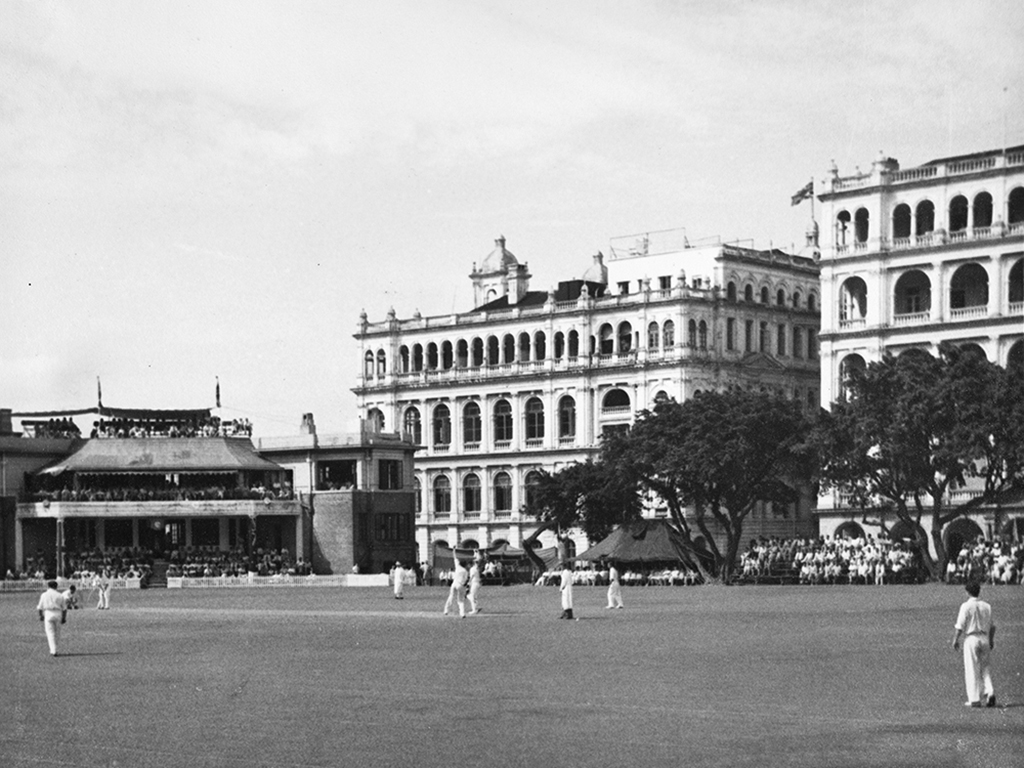
Chater Garden was once where the Hong Kong Cricket Club was located. The Cricket Club was established by the British in 1851 as the first cricket club outside of the country, as well as one of the oldest sports venues in Hong Kong. In the early days, the Club had a pavilion built of bricks and wood. By the 1920s, the pavilion was converted into a two-storey clubhouse. In 1975, due to the construction of the Mass Transit Railway, the Club moved to the current site at Wong Nai Chung Gap, and in 1978, this site was turned into Chater Garden.
In the past, the Cricket Club only allowed foreigners to obtain membership. It was not until the establishment of the Hong Kong Cricket Association in 1968 that Chinese participation was then accepted. The Cricket Club was adjacent to the Hong Kong Club. The two clubs had a close relationship with each other. Members of the Cricket Club who turned 30 years old could join the Hong Kong Club upon referral. Shortly after the Chater Garden was built, a foundation stone was relocated to the site. This stone was set in 1890 and was initially located near the pavilion of the Cricket Club to commemorate the commencement of the reclamation project in the Central District. Its current location is close to its original site.
Photo courtesy of the Billie Love Historical Collection and Historical Photographs of China, University of Bristol
Supreme Court Building
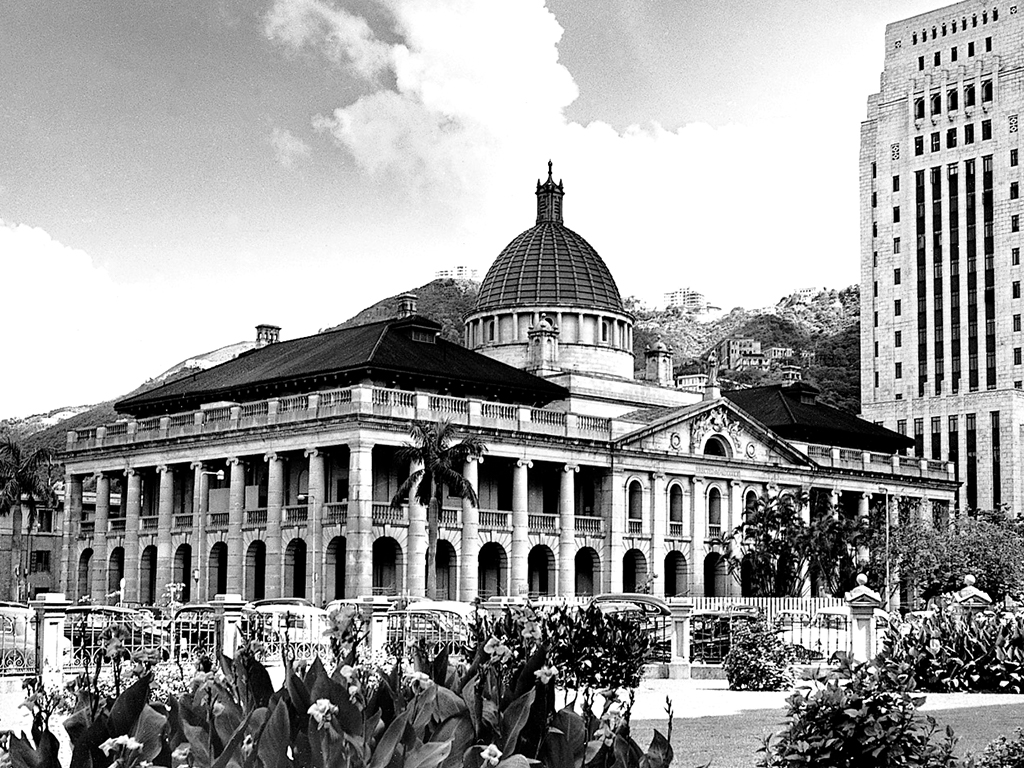
Construction of the Supreme Court building, a symbol of Hong Kong’s judicial system, began in 1900 and was completed in 1912. The architect in charge designed the south facade of Buckingham Palace. The most distinctive element of the building is the statue of Justice, Themis, which was erected on the top of the frieze. The statue holds a pair of scales on the right that represents fairness, and a sword on the left that symbolises power. The blindfold on her eyes represents the court’s impartiality. In 1984, the exterior of the building was declared a monument.
The Supreme Court Building is located in a reclamation area, and its foundation is composed of Chinese fir trees. During the construction period, due to a lack of masons and changes of plans, it took a total of 12 years for its eventual completion. The building was still standing despite the World War II artillery fire but was closed for maintenance due to the construction projects of the Mass Transit Railway in 1978. In 1984, the building was renovated and was used by the Former Legislative Council from 1985 to 2011. It was then converted to the Court of Final Appeal in 2015. The building has undergone many changes, but its importance in the development of Hong Kong’s legal system remains unchanged.
Photo courtesy of FormAsia Books Limited
St John’s Cathedral
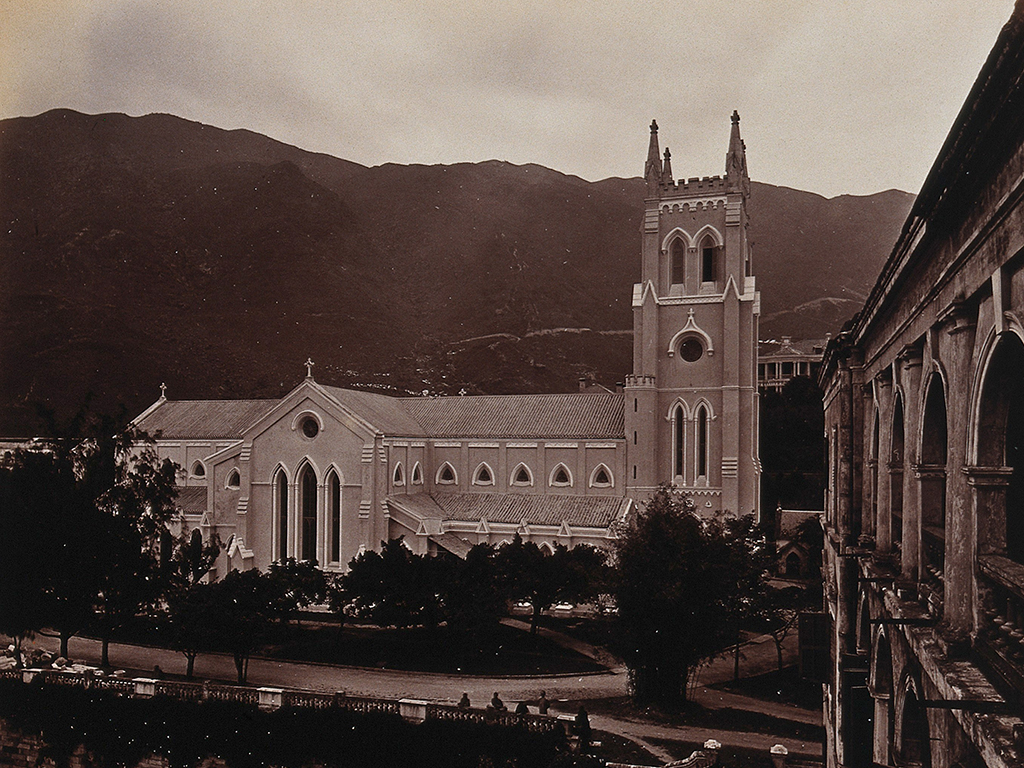
St John’s Cathedral, established by foreign missionaries, was completed and consecrated in 1849. The building reflected the Victorian Gothic style, which favoured natural light. For example, the sunlight passes through the east side stained glass windows depicting a crucifix, to project the image of the heaven that people yearn for. In 1872, the chancel and transepts were added to the cathedral, and the auxiliary hall was then built in 1921. In 1941, the tower and the clock were destroyed during the war, and the building was converted into a public hall and a Japanese club by the Japanese army. In 1996, the cathedral was listed as a declared monument.
The Old Hall of St John’s Cathedral was opened for public use in 1921. For example, it was used as a location by the members of the Royal Navy to host a winter dance event. The cathedral also raised clothes and medicines for lepers and missionaries since 1931. Bishop Ronald Owen Hall of the cathedral had been working on this site before founding an orphanage in Tai Po (now the St Christopher’s Home) in 1937. To this day, the Cathedral provides various community services to people in need.
Hong Kong: St John’s Cathedral, North Front
Photograph by W.P. Floyd, ca. 1873
Photo courtesy of Wellcome Collection. CC BY
Animation:

The history of Hong Kong Cricket Club founded by the British, goes back to 1851 as one of the longest-running sports clubs in the city. Participation in sports activities was popular amongst foreign businessmen in terms of developing their social networks at the time.