Central – Pottinger Street ca.1930
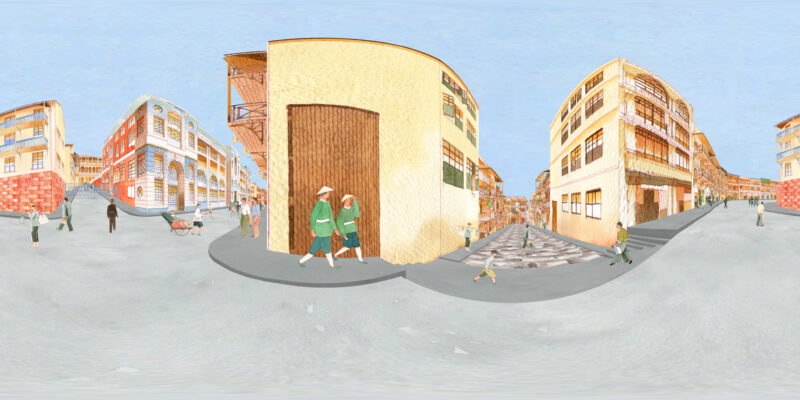
360-degree panoramic artwork created by Flyingpig
Historical Hotspots:
Pottinger Street

Pottinger Street, named in memory of Sir Henry Curwen Pottinger, the first Governor of Hong Kong, was built in the 1840s and is one of the oldest roads in the city. This street connected to Hollywood Road and Queen’s Road Central, and after reclamation projects in the Central District, was extended to Connaught Road Central. To cope with its steepness, the upper half of the street was paved unevenly by granite stone steps that made it easier for pedestrians to ascend and descend as well as allowing rainwater to drain. Due to its unique design, the street is also called “Stone Slab Street” by locals.
Stone Slab Street, well known by local Hong Kong people, has a rarely known facility. An underground public toilet was built on the street side close to Queen’s Road Central in 1914. Toilets were not common in old Hong Kong Chinese tenements in the past. In view of land scarcity in Central and Sheung Wan, the government developed public toilets underground. But at the time, those were for men only. Today, the one on Stone Slab Street has been rebuilt into a metre room. However, the ventilation pipe of the toilet between the hawker stalls is still preserved.
Photo courtesy of Special Collections, The University of Hong Kong Libraries
Police Headquarters Block

The Police Headquarters Block, part of the Central Police Station Compound, was completed in 1919. It was one of the biggest police stations in Hong Kong. The building was built on a slope with two main doors, respectively facing Hollywood Road and the Barrack Block. The headquarters had two different unique designs on its parts. The side across from Hollywood Road was 4-storey high, structured with oversized columns and large arch windows. The side opposite to the Barrack Block was only constructed with 2 storeys, The Central Police Station was responsible for law enforcement, while the Former Central Magistracy was accountable for justice and the Victoria Prison oversaw the imprisonment. The compound was the centre of law and order in early Hong Kong.
In its early years, the Hong Kong police force comprised members with various ethnicities. The English letters of the badge on the police uniform were used to identify the nationalities of the police staff. “A” represented Europeans, “B” represented Indians, “C” represented Chinese and “D” represented Shandong Chinese. The Police Headquarters Block was not only for general offices but also had residences for the Chinese and Indian police officers. A prayer room was also built in the basement for members of the Sikh and Muslim religions.
Recent photo. Photo courtesy of City University of Hong Kong. Photograph by Violette Chung.
Barrack Block

One of the oldest structures within the Central Police Station Compound is the Barrack Block built in 1864, and it was also one of the earliest Police Headquarters in Hong Kong. In its early days, the building was only 3-storey high, serving as dormitories for the police force, police stations, and offices for senior police officers. The fire service team was also stationed at this location in its early years. Afterwards, the space became insufficient and an additional floor was added in 1905. The Barrack Block was built with red bricks and granite, which was a feature of early colonial architecture. Only the significant architectures could be constructed with granite during Hong Kong’s early development.
The Parade Ground between the Barrack Block and the Police Headquarters Block was formerly the location of parade and drill activities in its early years and then became a parking lot. A huge mango tree standing within the Parade Ground was said to remain at least half a century. A rumour was told in the Police Force, that if the tree bore plenty of fruit, it would be a good year for promotion. The amount of the mango tree yielded was an indicator of the number of police officers to be promoted. Hence, the tree was named “the mango tree of promotion”. Since the Police Force left, the mango tree still grows strong and lush.
Photo courtesy of Government Photo Store, Information Services Department
Hollywood Road

Hollywood Road, built in 1840, is one of the oldest streets in Hong Kong. The road was about one kilometre long, extending from Possession Point to the area close to Central Police Station. Possession Point was the location where the British army landed in Hong Kong and used Hollywood Road for the transportation and logistics of military supplies. Hollywood Road ran through the neighbourhood of the Chinese and Western communities, connecting the remarkable buildings including the Government Central School, Man Mo Temple, To Tsai Church and Central Police Station, which shaped the unique blend of eastern and western influences in early Hong Kong.
Hollywood Road had close ties with Dr. Sun Yat-sen. He once studied at the Government Central which was located at the intersection of Hollywood Road and Gough Street. Sun was a medicine student at the Hong Kong College of Medicine within the Alice Memorial Hospital located at 77 to 81 Hollywood Road and became one of the first graduates in 1892. During his time in school, he often attended religious services at the To Tsai Church on 75 Hollywood Road.
The aerial photo(s) reproduced with permission of the Director of Lands. © The Government of the Hong Kong SAR. Licence No. G18/2020
Movie Hotspot:
CITY IN TIME incorporates cinematic elements at designated locations. Check out these filming locations of Hong Kong movies, where you can revisit classic Hong Kong movie clips on-site or stills on the website:
Infernal Affairs III

The Infernal Affairs trilogy is a local classic film series in the crime genre. It revolves around the story of an undercover triad member Lau Kin-Ming (Andy Lau) and an undercover cop Chan Wing-Yan (Tony Leung). Both must gather intelligence while maintaining the secrecy of their identities.
Infernal Affairs lll, released in 2003, uses parallel storytelling, cutting between the past and the present, to depict Chan’s quest to uncover the secrets of Triad boss Sam (Eric Tsang). The film won numerous awards, including Top 10 Chinese-language Film at the 9th Golden Bauhinia Awards, and Best Actor (Andy Lau) at the 41st Golden Horse Awards.
Footage shows the undercover cop Chan (Tony Leung), walking on Pottinger Street in Central while eating an apple and talking on the phone with his boss (Anthony Wong).
Courtesy of Media Asia Film Distribution (HK) Limited
Animation:

The police motorcycles were designed with bucket-like seats and began its operation in the 1920s. It was mostly assigned for patrolling, controlling traffic and carrying senior police officers who performed duties. This kind of motorcycles gradually faded out in the 1970s.