Lei Yue Mun – Viewing Deck 5 1970s
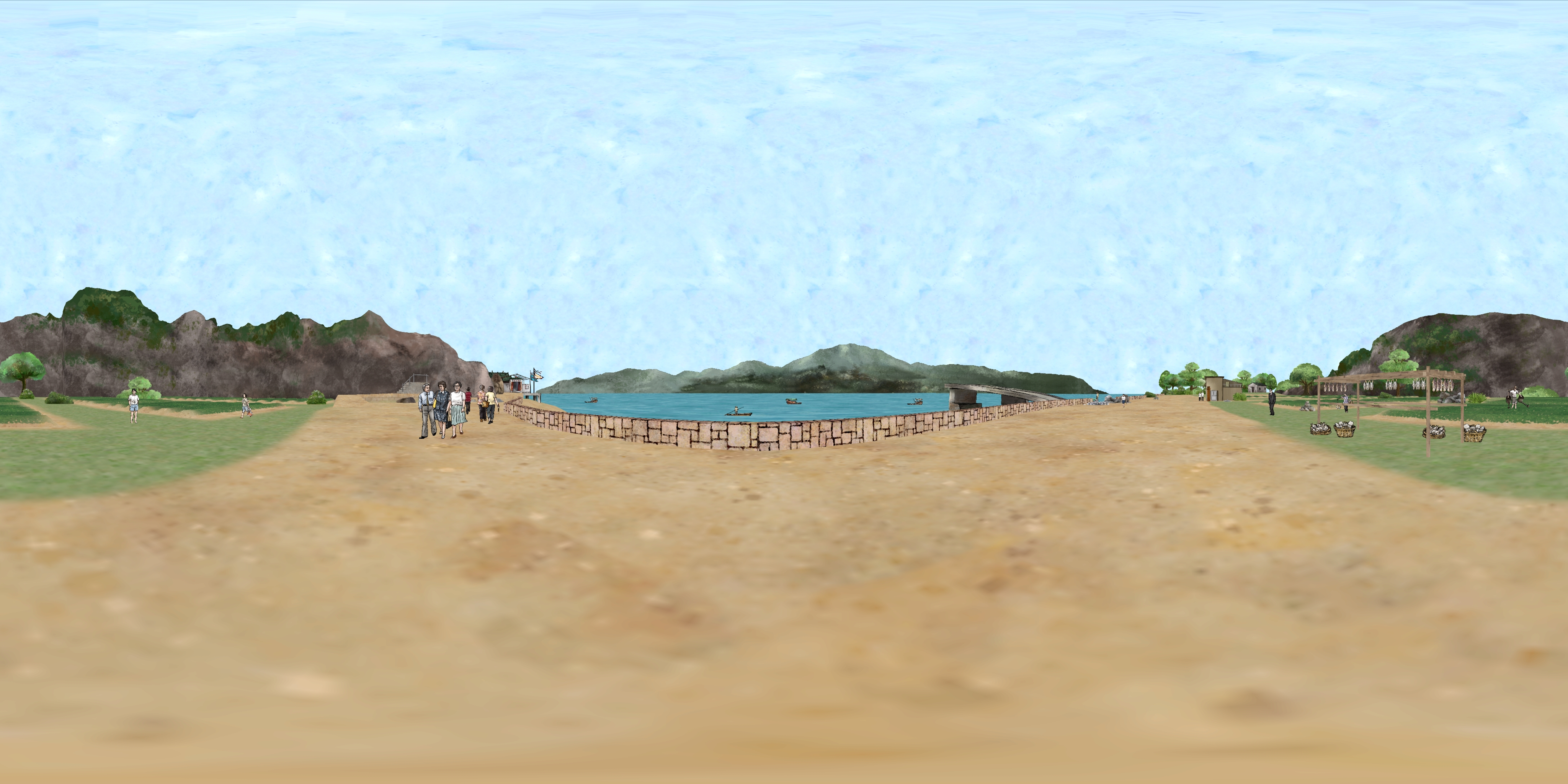
360-degree panoramic artwork created by LittleJade
Historical Hotspots:
‘Zi Liu Hai Shi’ Stone

There are several gigantic stones outside the Lei Yue Mun Tin Hau Temple, each inscribed with four Chinese characters depicting Lei Yue Mun’s scenery, including ‘Zi Liu Hai Shi’ (literally: Marsh, Stream, Sea & Waterfront) inscribed by a famous local calligrapher, Au Kin Kung (1887- 1971). Mr. Au studied the calligraphy style of the Late-Qing stone calligrapher Zhao Zhiqian, known as the Beiwei Style and he created a unique Beiwei typeface. This Beiwei typeface features thick strokes and bold fonts, giving a sense of solidity and reliability.
Between the 1950s and the 1970s, the Beiwei typeface could be seen on the signboards of many shops, including dried seafood shops and restaurants, government institutions and temples. Beiwei typeface sign boards were once all over Hong Kong, bringing a unique visual effect to the streets of Hong Kong.
Recent photo.
Photo courtesy of City University of Hong Kong.
Photograph by Mike Lau.
Tin Hau Temple

Lei Yue Mun Tin Hau Temple, located next to Lyemun Pass, was established by Qing pirate Zheng Lian-chang and made it as his stronghold in 1753. Zheng was a descendant of Zheng Jian, a subordinate of the anti-Qing general Zheng Chenggong. The temple underwent three major renovations in 1953, 1986, and 2012, which were made possible with the contributions from the residents and seafood industry of Lei Yue Mun, as well as devotees of Tin Hau. Residents of Lei Yue Mun highly value the Tin Hau Temple, not only as a place of worship but also as an ancestral hall and community centre uniting all the residents. There was once a resident who borrowed tableware and utensils from the temple for a wedding banquet before there was any restaurant in Lei Yue Mun.
The main deity worshipped in Tin Hau Temple is Tin Hau, also known as the Goddess of Heaven. Originally named Lin Mo and born in the Song dynasty, Tin Hau had cured people with illnesses and saved people from shipwrecks during her lifetime and was hence worshipped as a deity to protect the fishermen’s safety at sea. Next to the Tin Hau Temple is Hip Tin Temple, which is dedicated to deities such as Guan Di and Guan Yin.
Lei Yue Mun Tin Hau Temple was accorded as a Grade 3 Historical Building in 2010, demonstrating its historical value.
Photo courtesy of Mr Chor Kam Hung
Lei Yue Mun Tin Hau Festival

Hong Kong’s Tin Hau Festival is inscribed on the Fifth National List of Intangible Cultural Heritage. While most Tin Hau Festivals in Hong Kong are celebrated in the third lunar month, the activities of Lei Yue Mun Tin Hau Festival are held in the mid-late fourth lunar month. There are three important activities: The Hakka Unicorn Dance, Cantonese opera offerings to deities, and grabbing Fa Pau (literally: paper floral tributes). The Hakka unicorn, also known as Kirin or Qilin, is a traditional Chinese auspicious beast. Hakka unicorns are known for their good temperament and are beloved by the Hakka people. Hakka people in Lei Yue Mun perform the Hakka Unicorn Dance during the Tin Hau Festival to seek the blessings of the Hakka unicorn. Cantonese operas are performed during festive occasions to please the deities. The operas are usually performed on a temporary bamboo constructed stage near the Wishing Tree, close to the Lei Yue Mun Lighthouse, and the performances usually run for several days.
Fa pau grabbing is an essential eventin the Lei Yue Mun Tin Hau Festival. Fa pau, made of bamboo and paper, represented different blessings. In the past, Fa Pau Associations in Lei Yue Mun participated in the Fa Pau grabbing during the Tin Hau Festival, hoping for good luck. Nowadays, Fa paus are distributed to the lucky ones by drawing lots.
Photo courtesy of Ho Lap Tin Hung Kuen Martial Art Association
Animation:

Salted Fish Making Technique is one of the Intangible Cultural Heritage of Hong Kong. It is said that the practice in Lei Yue Mun was brought by outsiders known as Tanka people (people living on the boat), and it was very common from the 1970s to 1990s. The residents would buy fresh fish from merchants at a low price, use salt to marinate them and leave them in the sun to dry. Since only few residents had refrigerators at home, salted fish was popular because it could be preserved for a long time. With the rise of the seafood industry in the 1970s, more and more tourists were attracted to Lei Yue Mun and they would buy salted fish as souvenirs. There used to be a shop in Ma Wan Tsuen that specialised in salted fish. The types of salted fish now being sold in Lei Yue Mun are Chinese herring and threadfins.