Tai Hang – Wun Sha Street ca.1949

360-degree panoramic artwork developed from historical photos
Historical Hotspots:
Lung Kai Terrace
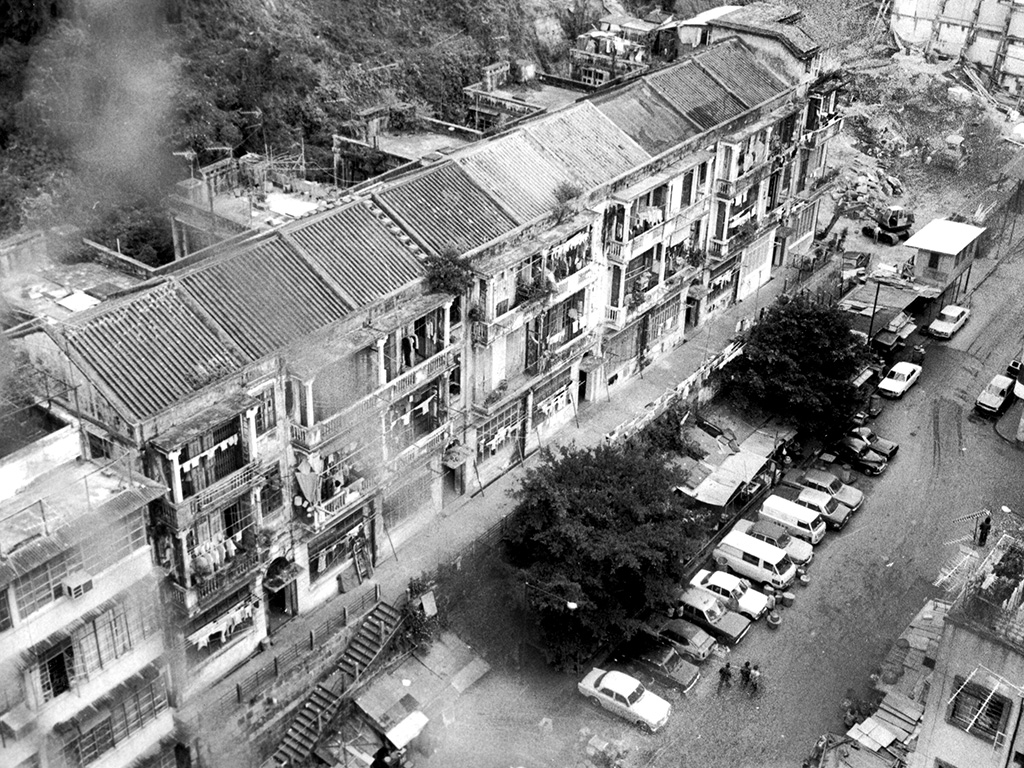
Tai Hang had many terraces, such as Illumination Terrace and Perfection Place. These were platforms of reclaimed land on a hillside with residential housing units. Invested by one or more owners, these terraces often emphasised design and did not skimp on labour costs. They were commonly seen on Hong Kong Island, where land was scarce in the last century. The remaining terraces today include Fung Fai Terrace (Happy Valley), Nam Koo Terrace (Wanchai), and Ching Lin Terrace (Kennedy Town). Tai Hang was a popular residential area in the 1930s. Lung Kai Terrace, on Wun Sha Street, comprised 10 contiguous old-style three-storey residential buildings with ‘East-meets-West’ architectural features, as exemplified by their pagoda-tiled roofs, artistically decorative arch door frames, and shaded balconies for ventilation.
In the 1940s, there was a market over the nullah beside Wun Sha Street, with stalls selling fish, meat and vegetables. In the 1950s and 1960s, Wun Sha Street was developed into a ‘Food Sreet’ where food vendors sold wonton noodles, milk tea, coffee, bean curd, beef offal, and the like on the roadside. In the 1980s, Lung Kai Terrace was rebuilt into the present-day Dragon Centre.
Photo courtesy of Hong Kong Housing Society
Haw Par Mansion

Are there really tigers and leopards in Haw Par Mansion? Haw and par mean ‘tiger’ and ‘leopard’ in the Chinese dialect. Haw Par Mansion was named after its owners, Aw Boon Haw (1883–1954), and his younger brother, Aw Boon Par (1888–1944). The mansion and adjacent garden (demolished and rebuilt as Ronsdale Garden and The Legend) were completed in 1936. The brothers were known for their brand, Tiger Balm, hence the garden’s name. It is said that the purpose of allowing free entry to Tiger Balm Garden was to advertise the Tiger Balm name, as well as promoting Chinese culture and Taoist philosophy. In the 1940s, there were only a few gardens (such as the Hong Kong Zoological and Botanical Garden and Blake Garden ) on Hong Kong Island. Hence, Tiger Balm Garden became a popular spot for locals to visit.
The architecture of Haw Par Mansion showcases ‘East-meets-West’ features. Its interior, made of modern building materials, retained the Chinese furniture and building components that feature tigers as design elements. In Tiger Balm Garden, the splendid Tiger Pagoda, over 40 metres high, faced Victoria Harbour and provided a view of the Eastern District. Tiger Balm Garden was once a popular attraction for both local people and visitors. It was commonly seen on postcards and was later become one of the scene for Street Fighter II, a world-renowned video game in the 1990s.
Photo courtesy of Special Collections, The University of Hong Kong Libraries
Nos. 30 and 31 Sun Chun Street

Until the early 20th century, Tai Hang was divided into a new village (Sun Wai) and an old village (Kau Wai or Lo Wai). Kau Wai, the area from Sun Chun Street up to the vicinity of the present-day Illumination Terrace, was settled by Hakkas from Stanley, Happy Valley, Wong Nai Chung Village, etc. after land resumption by the government on Hong Kong Island in the early 20th century. Sun Wai, the area from below Sun Chun Street down to Tung Lo Wan Road, was populated mainly by Punti (local) people.
From the 1940s to 1950s, most buildings on Sun Chun Street were one- or two-storey Chinese-style houses. Standing side by side, each sharing a gable wall with the adjacent units, these houses showed what Hakka villages used to look like. An example that can still be seen today is Nos. 30 and 31 Sun Chun Street, a one-storey house built by a Hakka family in Tai Hang sometime after 1894. It features granite external walls, an inversely V-shaped tiled roof, and a granite door frame. Its ground floor is raised slightly above street level. In 2021, it was listed as a Grade 3 Historic Building.
From the late 1950s to the early 1960s, due to the continuously increasing population of Hong Kong, old buildings in urban areas like Tai Hang were demolished and replaced by multi-storey buildings. Despite these changes, some buildings on Sun Chun Street still retain the layout of traditional houses, including the internal granite walls.
Photo courtesy of Cambridge University Library
Animation:

The nullah of Wun Sha Street was used for outdoor laundry since the beginning of the 20th century. The laundry workers beat clothes with wooden sticks, and since this action emitted a buk sound, washing clothes was commonly called buk-ing clothes. In addition to laundry workers, many residents gathered in the nullah to wash their clothes. This gave rise to the street name, Wun Sha Street, since wun means washing and sha means textiles. The small water tanks at the end of the street were mainly used by laundry workers who usually provided laundry services for foreigners and hospitals. Local people called it Fan Yi Tum (or Fan Yi Tong), meaning ‘Foreigners’ Clothing Pond’ in Chinese.