Central – Des Voeux Road ca.1870
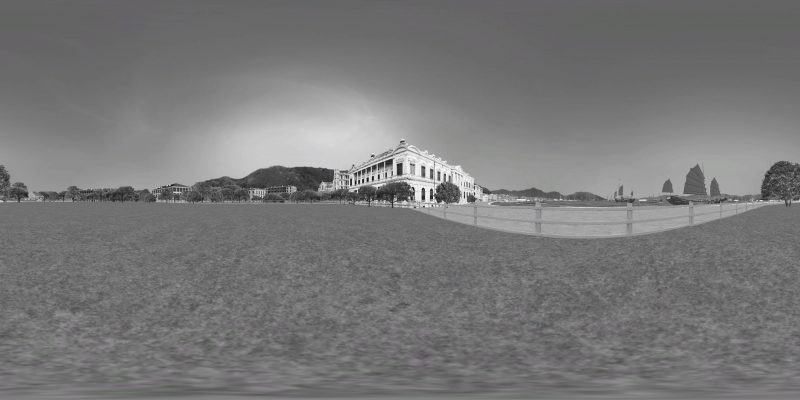
360-degree panoramic artwork developed from historical photos
Historical Hotspots:
The First City Hall
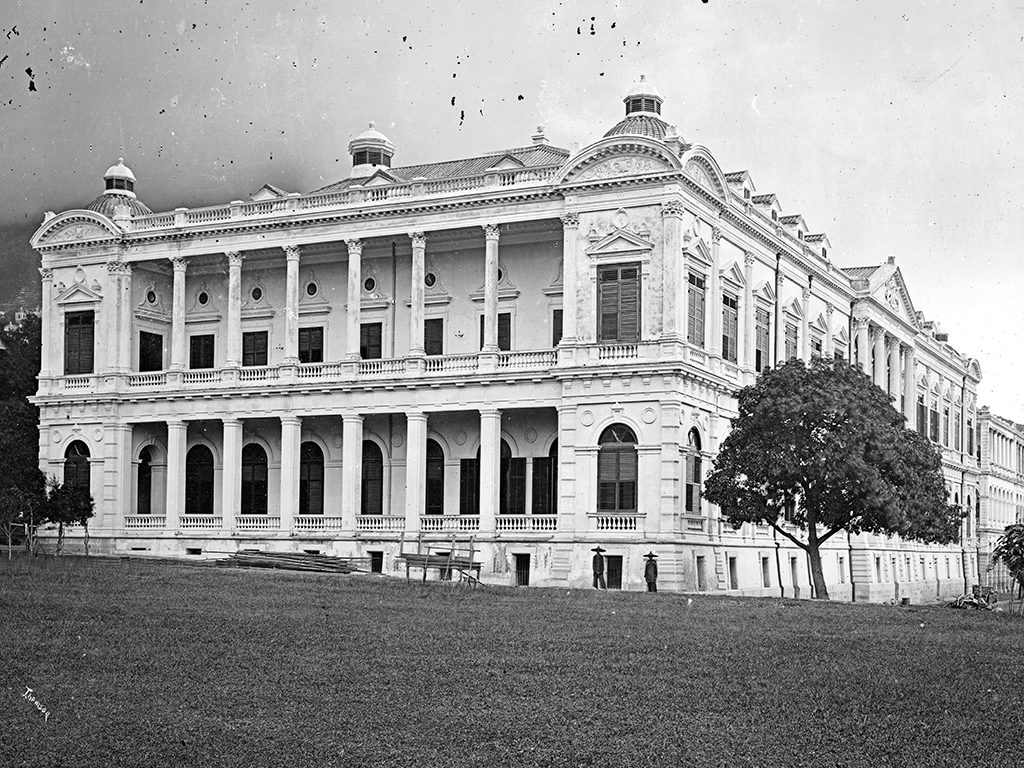
The first City Hall in Hong Kong was completed in 1869, and funds for the construction were raised from public subscriptions. The 2-storey building was designed in the Renaissance style, with facilities including halls, museums, libraries and theatres. In 1933, the government tore down part of the hall due to its dilapidation. HSBC acquired the west wing of the City Hall for its new headquarters. The rest of the land at east wing was acquired in an auction by the Bank of China, where they built the Bank of China Building in 1951. It was only until 1962 that the new City Hall was completed.
In the old days, City Hall was a social venue for the upper class to organise dancing parties, concerts and lectures. The Hong Kong College of Medicine for Chinese also hosted an opening ceremony at this location, during the famous Chinese revolutionary Dr. Sun Yat-sen’s studies. The museum in the City Hall opened to Chinese visitors in the mornings and reserved for foreigners in the afternoons. The City Hall was not considered to be rebuilt after being demolished until the 1950s, when the government and the public felt the need for the revival of culture.
City Hall, Hong Kong Photograph, 1981, from a negative by John Thomson, 1868/1871
Photo courtesy of Wellcome Collection. CC BY
Johnston’s House
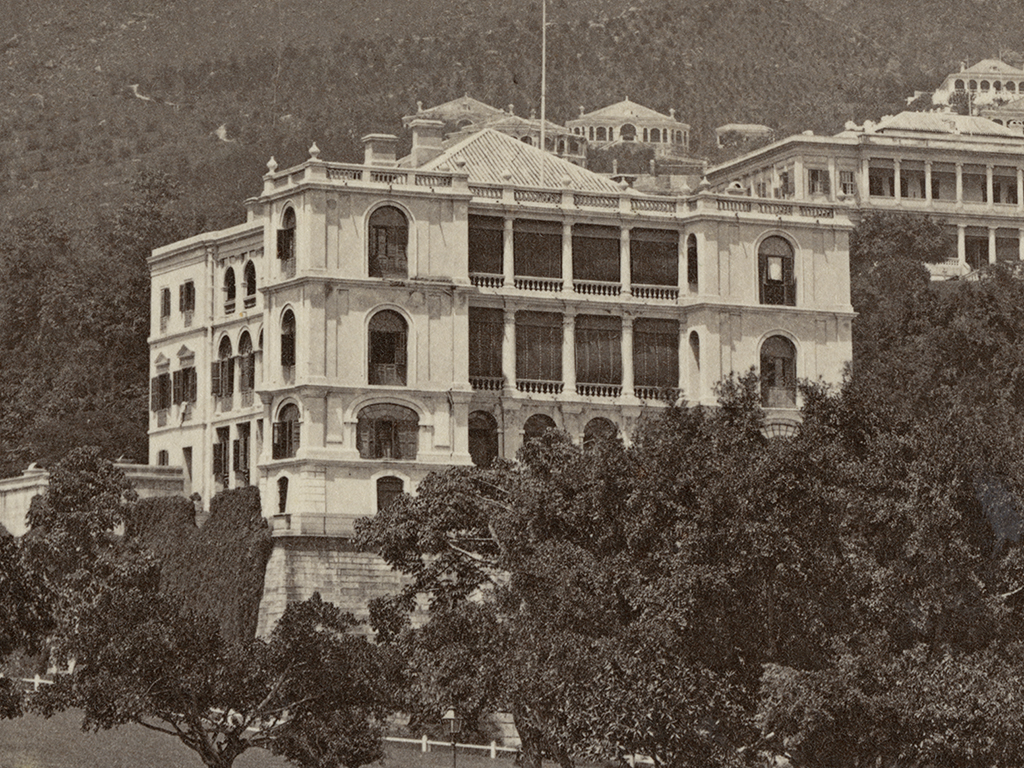
The Johnston’s House was completed in 1842 as a two-storey building made of stones and bricks. In 1860, the building was expanded with a third floor, a basement and two corner towers. In 1915, the Society of Foreign Missions of Paris purchased Johnston’s House and converted it into a neo-classical French Mission Building with granite and red bricks, and built a chapel topped by a cupola in the northwest corner. The building still keeps a niche where statues are placed, highlighting its religious purpose in the past. The Hong Kong government purchased the building in 1952 which was used by a number of departments. The building was listed as a declared monument in 1989.
The building served a variety of purposes and its name was changed overtime. It was viewed as the first Government House since the first Governor of Hong Kong, Sir Henry Pottinger authorised the Deputy Superintendent of Trade, Alexander Johnston, to build his official residence at this location. Later, Sir Pottinger and his successor Sir John Francis Davis lived in the house as a temporary residence. In 1879, famous businessman Emanuel Belilios purchased the building and renamed it as Beaconsfield House because he admired the British Prime Minister Benjamin Disraeli, the Earl of Beaconsfield. The building was also called “Kong Pek House” (the Chinese translation of Beaconsfield) by local Chinese people. The house was occupied by the Japanese army during wartime and following their surrender, the Hong Kong government expropriated it as its temporary headquarters. Following the acquisition by the government, the former Education Department and the Information Services Department set up their offices there. From 1997 to 2015, it was the site of the Hong Kong Court of Final Appeal.
Photo courtesy of Moonchu Foundation and the Hong Kong Museum of History
St John’s Cathedral
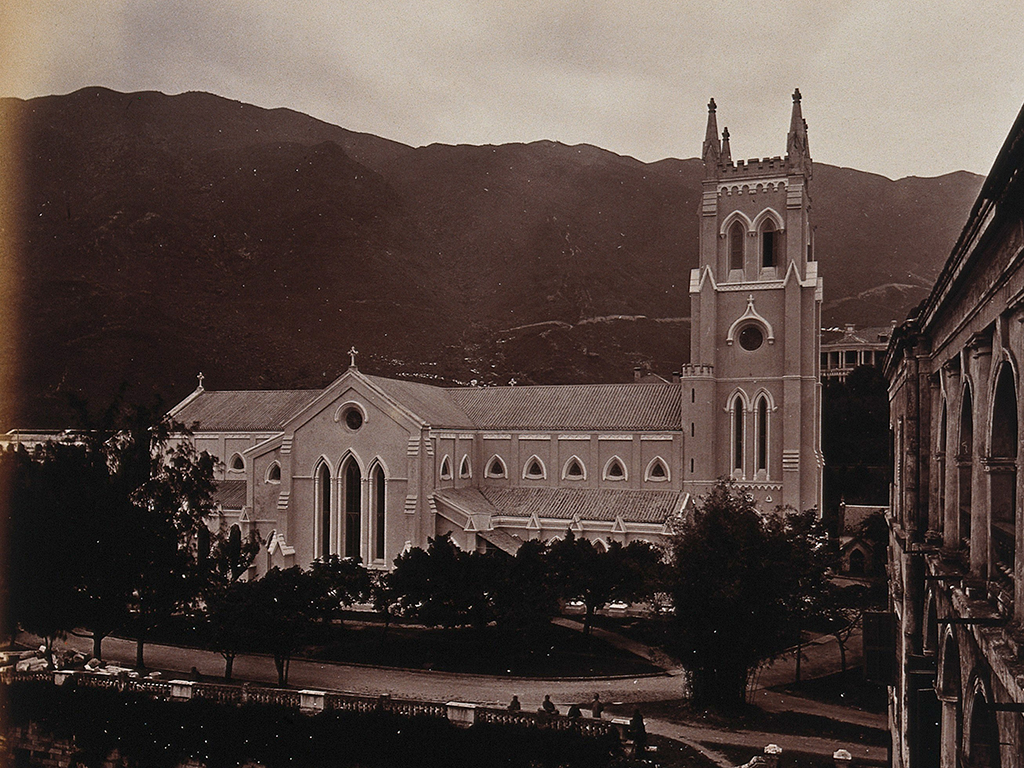
St John’s Cathedral, established by foreign missionaries, was completed and consecrated in 1849. The building reflects the Victorian Gothic style favouring natural light. For example, the sunlight passing through the stained glass windows on the east, south and north sides depicts different scenes from the life of Jesus. In 1873, the chancel was added to the cathedral, and the auxiliary hall was then built in 1921. In 1941, the tower and the clock were damaged during the war, and the building was converted into a clubhouse for the Japanese army. In 1996, the cathedral was listed as a declared monument.
The Old Hall of St John’s Cathedral was opened for public use in 1921. For example, it was used as a location by the members of the Royal Navy to host a winter dance event. The cathedral also raised clothes and medicines for lepers and missionaries since 1931. Bishop Ronald Owen Hall of the cathedral had been working in this site before founding an orphanage in Tai Po (now the St Christopher’s Home) in 1937. To this day, the cathedral provides various community services to people in need.
Hong Kong: St John’s Cathedral, North Front.
Photograph by W.P. Floyd, ca. 1873.
Photo courtesy of Wellcome Collection. CC BY.
Murray Barracks
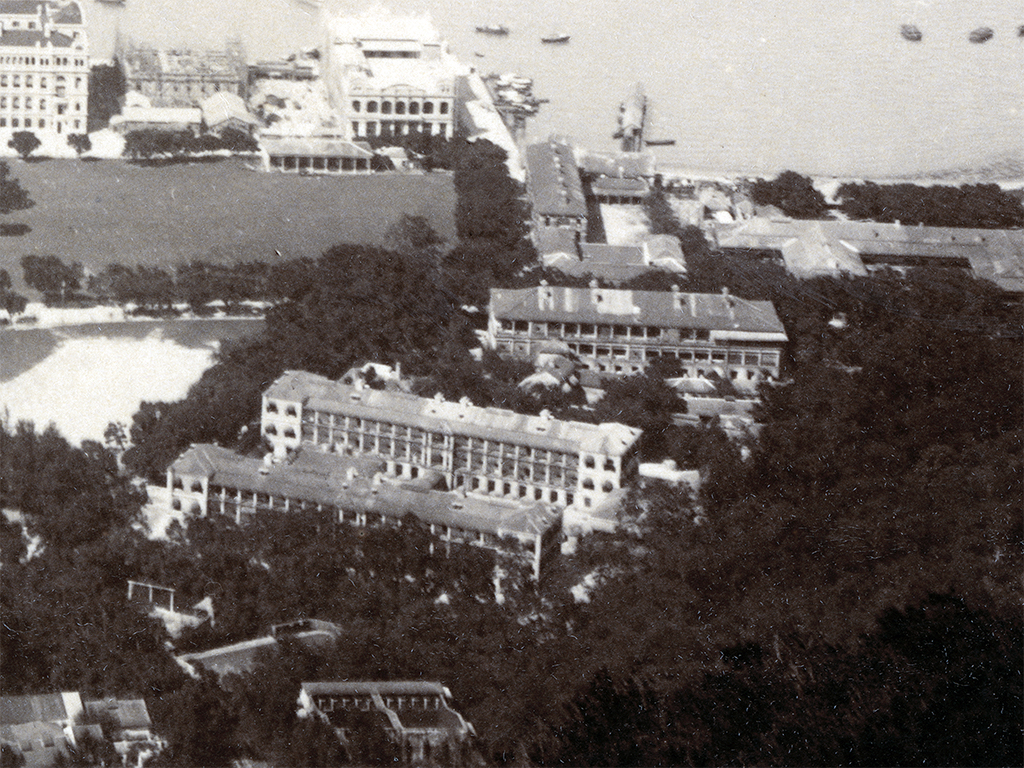
The Murray Barracks was the first British military barracks in Hong Kong and it was built in 1846 as a complex with the Murray House and two barracks. Both were named after Sir Murray, who served as the British Colonial Secretary from 1828 to 1830. The Murray House was designed in a classical style with a golden tiled rooftop, a typical architectural feature in the early colonial times. The barracks were used as officers’ quarters, officers’ clubs, and government offices. It was also turned into an office for the Japanese military police and the Japanese military command during World War II. Given the structural issues of the Murray House, in addition to a strong demand for land, the Hong Kong government demolished the building and auctioned the land in 1982. The Bank of China Building was constructed here in 1989.
The Murray House is of great historical value. To preserve the monuments, the Hong Kong Government adopted a new method of preservation. When the building was demolished, all 3,000 pieces of granite in the building were numbered and retained. The components of Murray House were stored in a government warehouse for 15 years and were finally reset in Stanley in 2000. Stanley would be a location to visit if you would like to explore century-old colonial buildings.
Photo courtesy of Moonchu Foundation and the Hong Kong Museum of History
Cricket Club
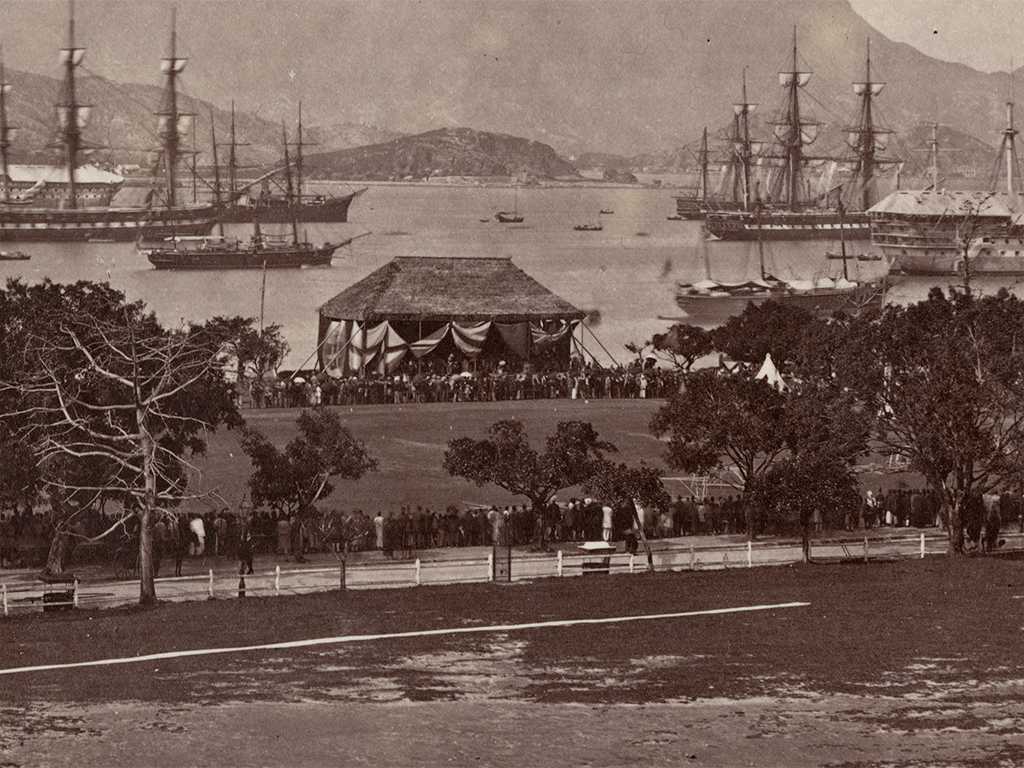
Chater Garden was once where the Hong Kong Cricket Club was located. The Cricket Club was established by the British in 1851 as the first cricket club outside of the country, as well as one of the oldest sports venues in Hong Kong. In the early days, the Club had a pavilion built of bricks and wood. By the 1920s, the pavilion was converted into a two-storey clubhouse. In 1975, due to the construction of the Mass Transit Railway, the Club moved to the current site at Wong Nai Chung Gap and in 1978 this site was turned into Chater Garden.
In the past, the Cricket Club only allowed foreigners to obtain membership. It was not until the establishment of the Hong Kong Cricket Association in 1968 that Chinese participation was then accepted. The Cricket Club was adjacent to the Hong Kong Club. The two clubs had a close relationship with each other. Members of the Cricket Club who turned 30 years old could join the Hong Kong Club upon referral. Shortly after the Chater Garden was built, a foundation stone was relocated to the site. This stone was set in 1890 and initially located near the pavilion of the Cricket Club to commemorate the commencement of the reclamation project in the Central District. Its current location is close to its original site.
Photo courtesy of Moonchu Foundation and the Hong Kong Museum of History
Wardley House
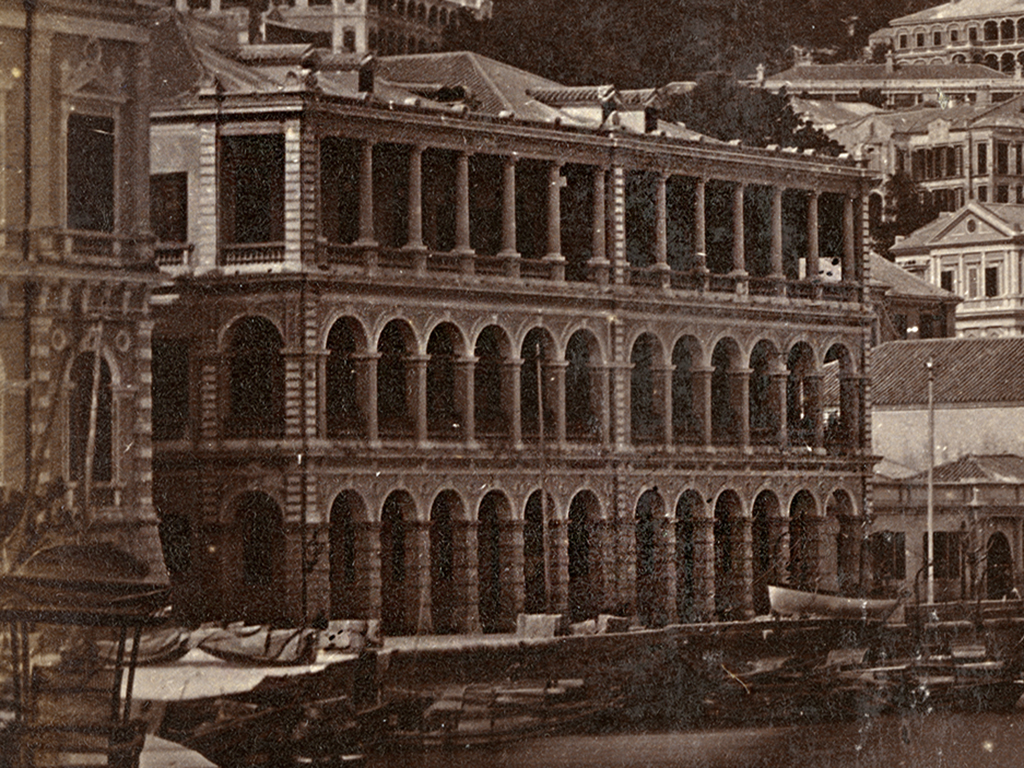
The Hongkong and Shanghai Banking Corporation Limited (HSBC) was established in Hong Kong and Shanghai in 1865 to finance China’s trade with the rest of the world. The company’s headquarters was located at Wardley House, 1 Queen’s Road, Hong Kong, which remains the bank’s head office address today. In 1882, HSBC decided to rebuild on the original site and the second-generation head office opened in 1886.
HSBC began issuing banknotes in Hong Kong and mainland China in 1865 to facilitate and accelerate regional trade. It quickly became Hong Kong’s main note issuer. In 1866, 6 of Hong Kong’s 11 foreign banks went bankrupt due to bank runs. The remaining banks shortened the payment deadlines of bank drafts, except HSBC. The bank maintained the same payment deadlines, thus solidifying its reputation with its customers. Despite a global recession in 1873, HSBC continued to expand and opened multiple branches across Asia, Europe and North America. By 1880, HSBC had become the primary banker to the Hong Kong government and the British government in Asia.
Photo courtesy of Moonchu Foundation and the Hong Kong Museum of History
Animation:

Dating back to Hong Kong’s early development, the sedan chair, produced from wood, was one of the major means of transportation and was of critical importance to the residents who lived in Mid-Levels and the Peak. Public sedan chairs were all numbered and set up with seats and upper covers. In 1863, the government implemented a license system to regulate the parking and fares of sedan chair business.