(sample only) Central – Statue Square ca.1960
Living in ca.1960

360-degree panoramic artwork created by Flyingpig
Historical Hotspots:
Supreme Court Building

Photo courtesy of FormAsia Books Limited
The construction of the Supreme Court building, a symbol of Hong Kong’s judicial system, began in 1900 and was completed in 1912. The architect in charge designed the south facade of Buckingham Palace. The most distinctive element of the building is the statue of Justice, Themis, which was erected on the top of the frieze. The statue holds a pair of scales on the right that represents fairness; and a sword on the left that symbolises power. The blindfold on her eyes represents the court’s impartiality. In 1984, the exterior of the building was declared a monument.
The Supreme Court Building is located in a reclamation area, and its foundation is composed of Chinese fir trees. During the construction period, due to lack of masons and changes of plans, it took a total of 12 years to its eventual completion. The building was still standing despite World War II artillery fire but was closed for maintenance due to the construction projects of the Mass Transit Railway in 1978. In 1984, the building was renovated and was used by the Former Legislative Council from 1985 to 2011. It was then converted to the Court of Final Appeal in 2015. The building has undergone many changes, but its importance in the development of Hong Kong’s legal system remains unchanged.
The Third HSBC Main Building

Photo courtesy of the American Geographical Society Library, University of Wisconsin- Milwaukee Libraries
Despite the global economic depression triggered by the Wall Street crash in 1929, HSBC illustrated its commitment to the city’s economic future by rebuilding its headquarters at 1 Queen’s Road to enlarge the treasury and provide more space for employees. This third generation of HSBC’s head office was completed in 1935 and stood 70 metres tall as the tallest building in Asia at that time. Recognised for its Art Deco style and avant-garde design, the structure used high-tensile steel to resist typhoons. It was also Hong Kong’s first air-conditioned building. It was demolished in 1981, replaced by new premises that opened in 1986.
Two mighty bronze lions stand guard at HSBC’s head office in Central. The calm one on the right is named Stitt and symbolises the bank’s stability and security. The roaring lion on the left, showcasing the bank’s strength and guardianship, is Stephen. During World War II, both lions were relocated to Japan, ostensibly to be used for scrap metal. Luckily, this did not occur and Stephen and Stitt returned to Hong Kong in 1946, both bearing shrapnel scars from the war.
Prince’s Building
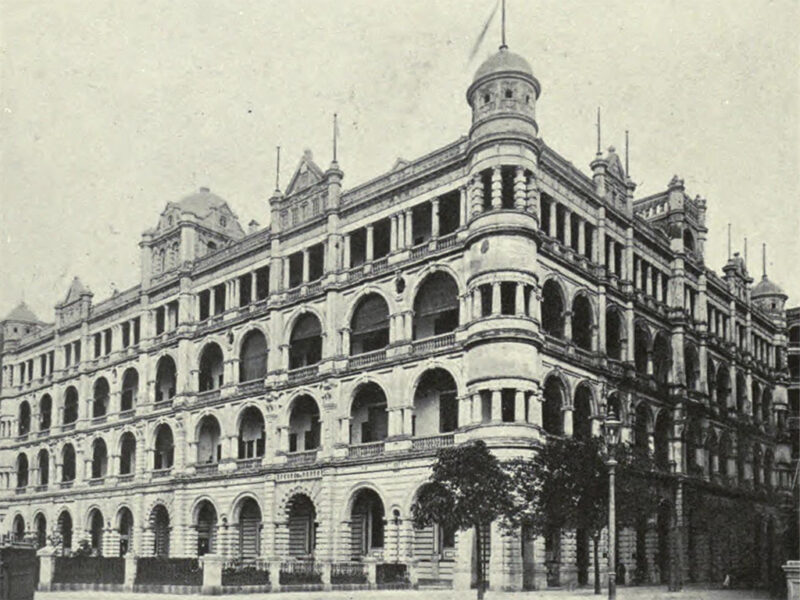
Photo courtesy of Special Collections, The University of Hong Kong Libraries.
Prince’s Building was completed in 1904 by Chater & Mody and entrusted to Hongkong Land for management. Its title was transferred a couple of times and then became the property of the Hongkong Central Estate Limited in 1914. It was later acquired by the bankers Joseph Brothers, then was acquired by Hongkong Land in 1927 and was demolished and reconstructed in 1962. In 1965, the 26-storey Prince’s Building was completed as an integrated complex for offices and shopping malls.
Mr. Chater named the Prince’s Building in memory of Queen Victoria’s eldest son, the Prince of Wales, who is King Edward VII. It was a well-known commercial building that attracted many international companies to settle their offices, including Japan’s Mitsui Bussan Kaisha, as well as companies from France, Portugal, Baghdad, the United States and the United Kingdom, and even law firms like Wilkinson & Grist, Deacons and Johnson Stokes & Master.
Queen’s Building
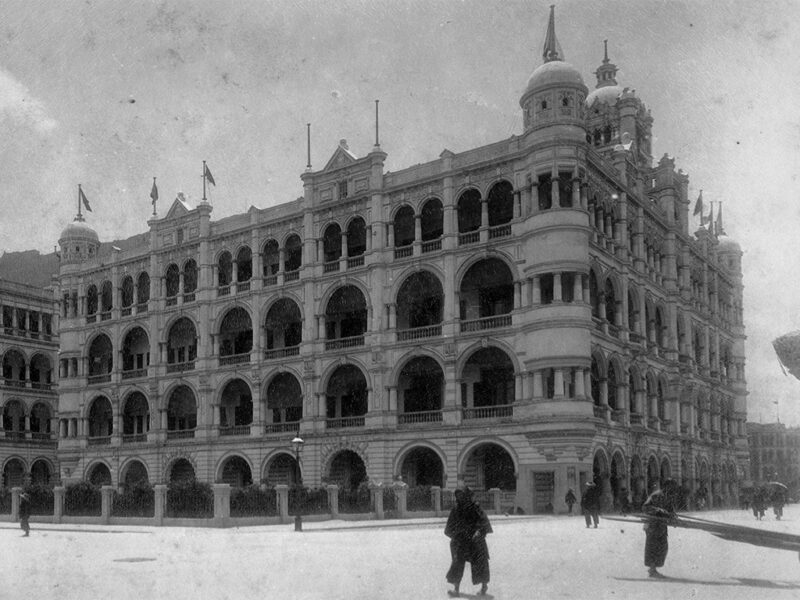
Photo courtesy of Moonchu Foundation and the Hong Kong Museum of History
In 1899, the Queen’s Building was completed. It was an Italian Renaissance-style commercial building with a total of 4 floors and 16 offices. The building was developed by Chater & Mody and later had the ownership transferred to the Hongkong Central Estate Limited. The building was managed by Hongkong Land starting in 1899. In 1923, the Hongkong Central Estate Limited and Hongkong Land were amalgamated through an exchange of shares, and Queen’s Building was merged in as assets of Hongkong Land. In 1960, the building was reconstructed into The Mandarin. The hotel opened in 1963, and it has become a multinational hotel group now.
The “Queen” in the name of the Queen’s Building refers to Queen Victoria. The Queen’s Building garnered great attention following its completion due to the unlikely grandiose appearance, despite its status as a commercial building. The Director of Public Works even mentioned in the 1899 annual report, “…the principal building completed in the city that year was the very handsome building now known as Queen’s Building”. This was once the consulates of Russia, Denmark and Norway. Hongkong Land had initially planned to exchange the Queen’s Building for three other properties owned by Jardines at the junction of Pedder Street and Des Voeux Road. After the proposal was rejected, the building was converted into a hotel.
Bank of China Building

Photo courtesy of P&T Group
Bank of China first established its Hong Kong branch in 1917, with fewer than 10 employees. After years of development, the bank made a successful bid, on the former site of City Hall in 1947. The 17-storey tower was completed in 1951, as the tallest building in Hong Kong at that time. It was confirmed as a Grade 1 historic building in 2009. The design of the building uniquely featured Chinese ornamental elements in the details. Placed at the east entrance are two uniquely shaped stone lions designed with Art Deco techniques.
The renowned Chinese-American architect Ieoh Ming Pei and his family contributed their three generations of work to Bank of China. Ieoh Ming Pei’s father was the first manager of the Hong Kong Branch; Ieoh Ming Pei designed the Bank of China Tower, and his son, Li Chung Pei, designed the new headquarters of Bank of China (Hong Kong) (“BOCHK”) Private Banking situated in the Bank of China Building. In 2017, BOCHK issued the “Bank of China (Hong Kong) Centenary Commemorative Banknote”. The front panel of the banknote features the Bank of China Tower, superimposed with the image of the Bank of China Building. These buildings symbolise the glorious history of Bank of China’s centenary of service to Hong Kong.
The Third Standard Chartered Bank Building

Photo courtesy of P&T Group
The long-established Standard Chartered Bank opened its first branch in Hong Kong in 1859. A century later, Standard Chartered Bank Building was completed and at that time, was considered as one of the tallest buildings in Hong Kong. The building was demolished in 1987 and rebuilt into a new Standard Chartered Bank Building two years later.
Standard Chartered Bank began issuing banknotes as early as 1862 and is now one of the three note-issuing banks in Hong Kong. The bank experienced many changes in the 1960s. It introduced computerisation in 1967, being one of the first banks in Hong Kong to do so. In 1969, the then Chartered Bank and Standard Bank merged to form “Standard Chartered PLC”. Later, the group was officially renamed “Standard Chartered”.
Movie Hotspot:
CITY IN TIME incorporates cinematic elements at designated locations. Check out these filming locations of Hong Kong movies, where you can revisit classic Hong Kong movie clips on-site or stills on the website:
City On Fire

Courtesy of Golden Princess Amusement Company Limited & Fortune Star Media Limited
City on Fire, starring Chow Yun-Fat and Danny Sau Yin Lee, was released in 1987. In the following year, it won Best Director (Ringo Lam) and Best Actor (Chow Yun-Fat) at the 7th Hong Kong Film Awards.
The film is about an undercover cop Ko Chow (Chow Yun Fat) who is about to resign from the police force when he is asked to take on one more case. His mission is to infiltrate a gang led by Fu (Danny Sau Yin Lee) to gain his trust.
The footage depicts Ko Chow (Chow Yun Fat) and Fu (Danny Sau Yin Lee) meeting for the first time at Statue Square, Central.
Animation:

Hong Kong Tramways started operations with its roots dating back to 1904, which has been one of the major means of public transport on Hong Kong Island since its early days. It is commonly known as “Ding Ding” in reference to the sound when the tram is riding. Des Voeux Road Central, since the 1960s, has been a hustling and bustling central business district at Central, where trams were ridden by people to commute from home to work.