Kowloon City – Kai Tak Stadium ca.1927
Historical Hotspots:
Sacred Hill and Sung Wong Toi

Since the early 20th century, Kowloon City’s landscape has undergone numerous changes. A boulder bearing the inscription ‘Sung Wong Toi’ (‘Terrace of the Song Emperors’) was once located on Sacred Hill to commemorate the last emperors of the Song Dynasty. Today, it stands in the Sung Wong Toi Garden as a testament to history.
The engraved boulder was originally located at the summit of a small hill with an elevation of approximately 100 feet. This hill was designated as ‘Sacred Hill’ on a map from the early 20th century. The Song Emperors landed on the coast of Kowloon City when they sought refuge in Hong Kong. To commemorate this event, the hill was named ‘Sung Wong Toi’, as inscribed on the boulder.
Following the collapse of the Qing Dynasty, many literati who had previously served the Qing Government relocated to Hong Kong, where they continued their scholarly endeavours by giving lectures. While visiting Sacred Hill, they composed poems and drew paintings in tribute to the Song Dynasty. These artistic works later formed the compilation ‘Sung Toi Cau Coeng’ (‘Autumn Chants at Sung Wong Toi’), an important work of early Hong Kong literature.
In 1899, Sir Ho Kai, a member of the Legislative Council at the time, advocated for the first conservation ordinance in Hong Kong to protect the Sacred Hill monuments from destruction. Local merchants also funded the construction of stone walls and archways to attract tourists, establishing Sung Wong Toi as one of the prominent tourist attractions on the Kowloon Peninsula at the time.
During the Japanese occupation, the Japanese military demolished the Sacred Hill to obtain stone for the expansion of the runway at Kai Tak Airport. Fortunately, the ‘Sung Wong Toi’ boulder remained undamaged. In 1959, the Government relocated the relic to the newly constructed Sung Wong Toi Garden near the original site of the Sacred Hill, where it continues to stand as one of the most prominent landmarks in Kowloon City.
Photo courtesy of Hong Kong Museum of History
Kai Tack Bund residential area

The Kai Tak Development is an urban renewal project to repurpose the former Kai Tak Airport site for residential, commercial, cultural and recreational uses. Over a century ago, a similar redevelopment plan for the area was proposed, but it was ultimately left unfinished.
In the early 1910s, many Chinese officials and business families relocated from South China to Hong Kong. Recognising a new market opportunity, Sir Ho Kai, Au Tack and other merchants established the Kai Tack Land Investment Company, Ltd. aiming to develop luxury properties in Kowloon City. They sought government approval for the reclamation of land along Kowloon Bay, north of Boundary Street. Their plan was approved in 1915, and funding was raised through a public offering.
The initial phase of reclamation, known as Kai Tack Bund, was completed in 1920, providing land for approximately 200 three-storey garden houses. The development included schools, a ferry pier, and bus services operated by Kai Tack Motor Bus Company Limited for commuting to and from Kowloon. However, the economic downturn of the 1920s, coupled with the 1925 Canton-Hong Kong Strike, rendered the finances of the project unsustainable and the buildings unsaleable. Therefore, the Kai Tak development was halted in 1926, leaving the remaining phases unfinished.
In the following year, the Government assumed control of the newly reclaimed land in Kai Tak and continued the reclamation works. Scrapping the original housing plan, it repurposed the site for the development of aviation facilities. During the Japanese occupation, the Japanese military demolished the residential area of the Kai Tack Bund to obtain sand and gravel for the expansion of the airport runway. ‘Kai Tak’ remained only as the area’s designation.
Today, the site has been transformed into a new world-class landmark, Kai Tak Sports Park, marking a milestone in the development of sports and mega events in Hong Kong.
Photo courtesy of Government Photo Store, Information Services Department
Kai Tak Aerodrome

In the 1920s, the British Government searched for an ideal location to establish an Air Force station, requiring a flat expanse of land along the coast. They ultimately chose Kai Tak, opting against an alternative site on grassland in Yuen Long. At that time, Kai Tack Land Investment Company Ltd., which was responsible for the reclamation of land along Kowloon Bay, was experiencing financial difficulties. The Government seized this opportunity to acquire the land and renamed the site ‘Kai Tak Aerodrome’ due to its proximity to Kai Tack Bund. It was later officially designated as ‘Kai Tak Airport,’ marking the beginning of Hong Kong’s aviation history.
In 1927, the Royal Air Force began mooring military seaplanes at Kai Tak, which was then a grassy and sandy area with rudimentary facilities. Without a lighting system, only a few thatched huts were set up to provide shelter for the aircraft. The sole equipment in the yard was a steam crane, used to lift the seaplanes from the water onto the shore for parking and maintenance. By 1934, the aerodrome underwent expansion, incorporating a seawall and slipway to facilitate the direct towing of seaplanes to the shore. Single-story barracks were also constructed to accommodate the stationed air force. In 1935, Kai Tak was officially designated as a Royal Air Force base.
In 1936, Kai Tak Aerodrome witnessed its inaugural international flight from Hong Kong to Penang, marking the beginning of Hong Kong’s civil aviation development. Unlike a direct flight from Hong Kong to London which take approximately 14 hours nowadays, the journey spanned 10 days back in those days, with stops in Penang, India, and the Middle East.
Photo courtesy of The National Archives of the United Kingdom
Lung Tsun Stone Bridge

The southeast end of the former runway at Kai Tak Airport has now been transformed into a cruise terminal. Over a century ago, a pier in the Kai Tak area called Lung Tsun Pier served as a link between Kowloon City and other destinations.
Built in 1875, Lung Tsun Pier featured a 200-metre-long stone bridge, from the east gate of Kowloon Walled City to the sea. In ancient times, city gates were strategically positioned in areas believed to possess the strongest ‘dragon energy’, connecting land to rivers or coastlines through bridges. This aspect of urban planning, rooted in feng shui principles known as ‘Gathering the Dragon (Lung) and Connecting the Piers (Tsun),’ or simply ‘Lung Tsun’, was thought to bring good fortune to the city. Lung Tsun Pavilion was built at the Kowloon Bay entrance to Lung Tsun Stone Bridge, to provide rest and shelter from rain for passing pedestrians. When officials arrived at Kowloon City, they were typically received and welcomed there, earning the pavilion the additional name ‘Jip Kwun Ting’, meaning Pavilion for Greeting Officials.
Amid Kowloon City’s urban development, the bridge and pier underwent several renovations. In the 1920s, Kowloon City expanded through land reclamation, resulting in the north end of the bridge being submerged and the pavilion being demolished. In 1933, the Kowloon City Pier – distinct from the present-day Kowloon City Ferry Pier – was constructed at the south end of the bridge with reinforced concrete. During the Japanese occupation, the Japanese military reclaimed more land to expand the airport, burying the south end of the bridge and the pier.
The tablet inscription ‘Lung Tsun’ was incorporated into the entrance gate of the former Lok Sin Tong Primary School, and ‘Lok Sin Tong’ was inscribed on the back. The Primary School ceased operations in 2019 and was later repurposed as ‘transitional social housing’. The tablet inscription was preserved in situ. During the initial phase of the Kai Tak Development project, which began in 2008, archaeological investigations uncovered remnants of the pavilion and the bridge, including the foundation stone of the pavilion and some bridge pillars. The Government decided to preserve these historical artefacts in situ for future public display.
Photo courtesy of Hong Kong Museum of History
Animation

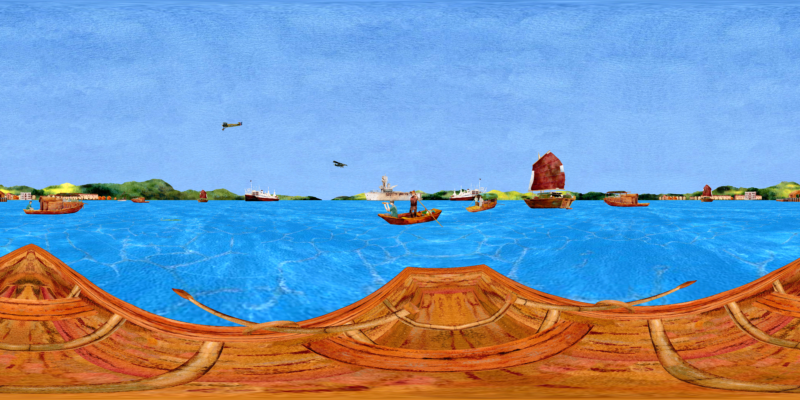
In the 1920s, the aviation facilities were used primarily for military purposes. Unlike traditional land aircraft, seaplanes can take off and land without a runway, provided there was sufficient water surface area. At the time, they were also the only type of aircraft capable of intercontinental flights. The Government considered various sites for an airbase, including a vast grassland area in Yuen Long, but ultimately chose the reclaimed area near the waterfront in Kai Tak.
In its early days, Kai Tak Aerodrome’s had rudimentary facilities, relying on steam cranes to lift seaplanes onto the shore for parking and maintenance. Only in 1934 was a slipway added to enable seaplanes to directly transit from the seawall into the water for takeoff.