Lei Yue Mun – Viewing Deck 1 1960s
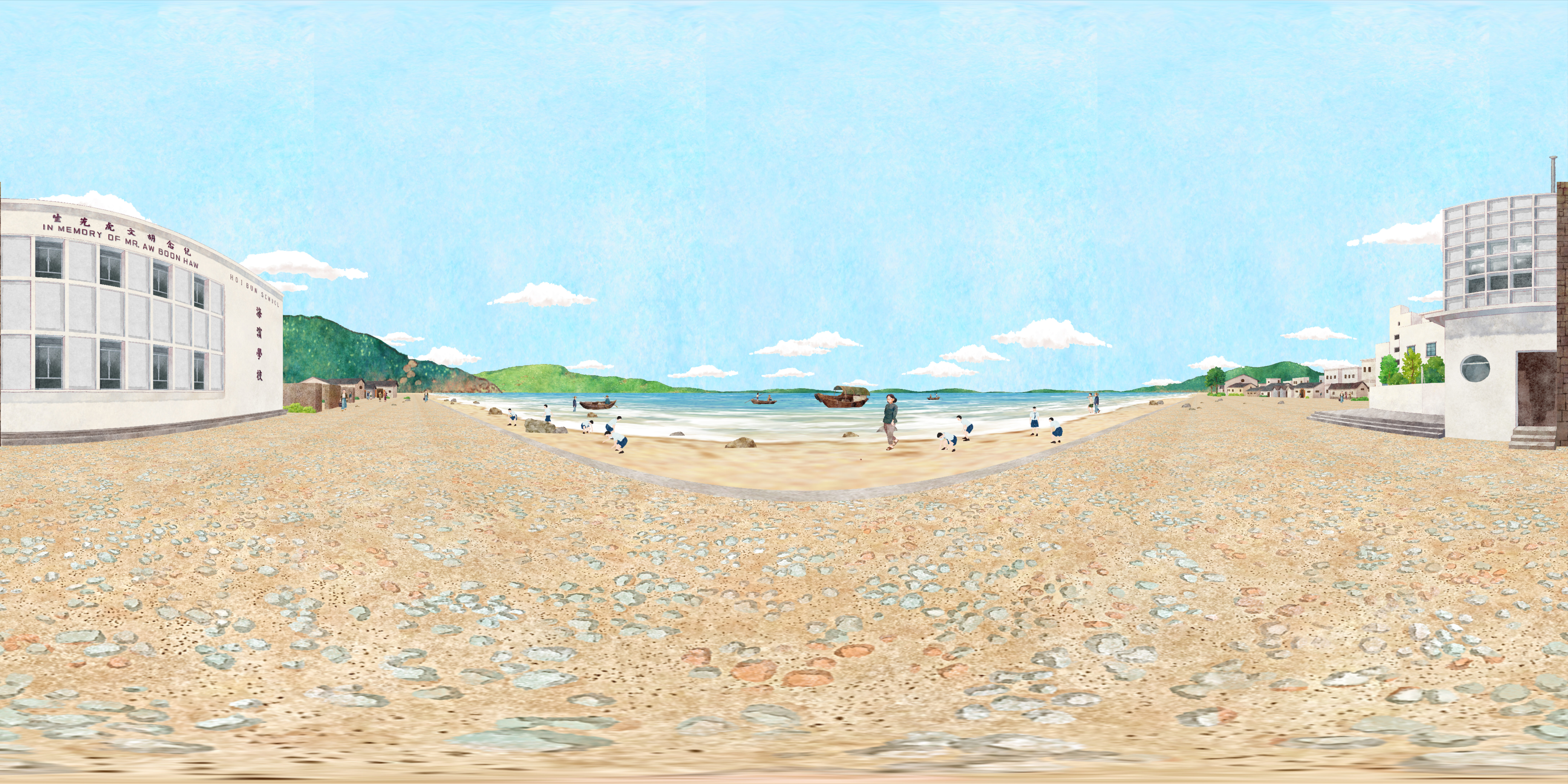
360-degree panoramic artwork created by Carmen Ng
Historical Hotspots:
Hoi Bun School

The predecessor of Hoi Bun School was a village school called ‘Enlightenment School’, established in 1920. It was officially registered as Lyemun School in 1936 and suspended in 1941 when the Japanese troops occupied the village and destroyed the school. After the Japanese Occupation, the villagers resumed the school in a cottage at the harbourfront in 1946 and named it ‘Hoi Bun School’ (literal translation: Harbour Front School). The current campus is a second-generation school campus that was donated by generous residents and donors in 1959.
The first generation Hoi Bun School adopted multi-grade teaching methods, in which students from two different grades were taught in the same classroom by one teacher simultaneously. This teaching method was used until the completion of the second generation Hoi Bun School campus. The student number was at its peak between 1960 and 1970 with more than 500 students from not only Lei Yue Mun, but also Lam Tin, Kwun Tong, and even Shau Kei Wan on Hong Kong Island.
In the 1960s, some teachers introduced the addition of a ‘torch handover’ ritual to the graduation ceremony whereby graduates passed the torch to the next year’s students, symbolising the transmission of the school spirit from one generation to the next. Following the closure of Hoi Bun School, the campus has been revitalised and become the ‘Jockey Club Lei Yue Mun Plus’ which is open to public.
Photo courtesy of Jockey Club Lei Yue Mun Plus
Majestic Chemical Art Craft Manufacture

Majestic Chemical Art Craft Manufacture was the largest ceramic factory in Lei Yue Mun. It was known as the ‘Statue Factory’ as it mainly produced figures and animal models. The factory was founded by renowned potter from Jingdezhen, Jiangxi, Cho Ming Luen (1886-1982) and his friend, Yiu Woon Fun (1918-2014) in 1955. The ceramic factory produced various types of ceramics in the 1960s, including glazed elephant gate-pillars, replicas of porcelain cat pillows from the Song Dynasty and court lady figurines from the Tang dynasty. In 1969, it mass-produced glazed tiles with coin motifs for the Yuen Long and Yau Ma Tei branches of Far East Bank to decorate their main entrance walls.
Majestic Chemical Art Craft Manufacture also exported its products to overseas markets like the Europe, United States of America and Japan. However, with the opening of the mainland market, the local ceramic industry gradually declined, leading to the closure of Majestic Chemical Art Craft Manufacture in 1996.
Photo courtesy of Jockey Club Lei Yue Mun Plus
Sam Ka Tsuen

‘Lei Yue Mun’ was first recorded in the book Yuedaji (Grand Records of Guangdong) in the Ming dynasty. There are different explanations for the origin of the place name ‘Lei Yue Mun’. While some say that the shape of its water channel looks like a carp, others suggest that the rocks at the seaside resemble a carp or two giant carps fossilised themselves into both sides of the canals.
Sam Ka Tsuen is located in the Lei Yue Mun Typhoon Shelter of Yau Tong and its name is believed to originate from several clans that first came to settle in Lei Yue Mun in the 18th century: the Yips, Tsangs, and Cheungs. These three clans were regarded as the earliest groups engaging in quarrying activities in Lei Yue Mun. It was until the late 1960s when a reclamation project was undertaken that Sam Ka Tsuen was transformed into a typhoon shelter where boatmen could dock their boats.
Photo courtesy of Jockey Club Lei Yue Mun Plus
Animation:

Nature was the classroom of Hoi Bun School. During Physical Education lessons, students ran to the beach outside the school and collected shells along the shore. They also swam at the beach after classes.