Tsim Sha Tsui – Kowloon Park Drive ca. 1900
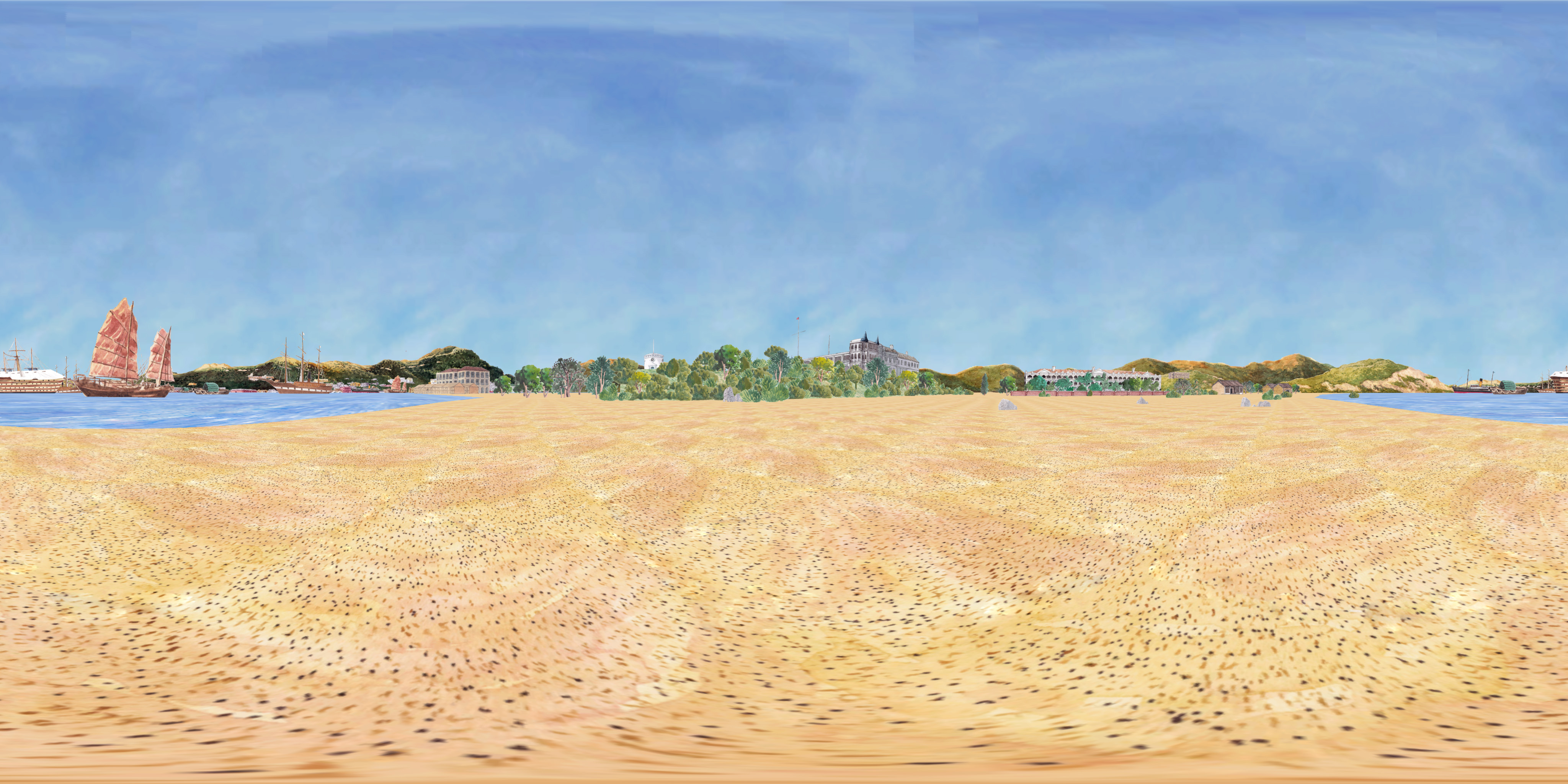
360-degree panoramic artwork created by Wong Chun Hei
Historical Hotspots:
Marine Police Headquarters
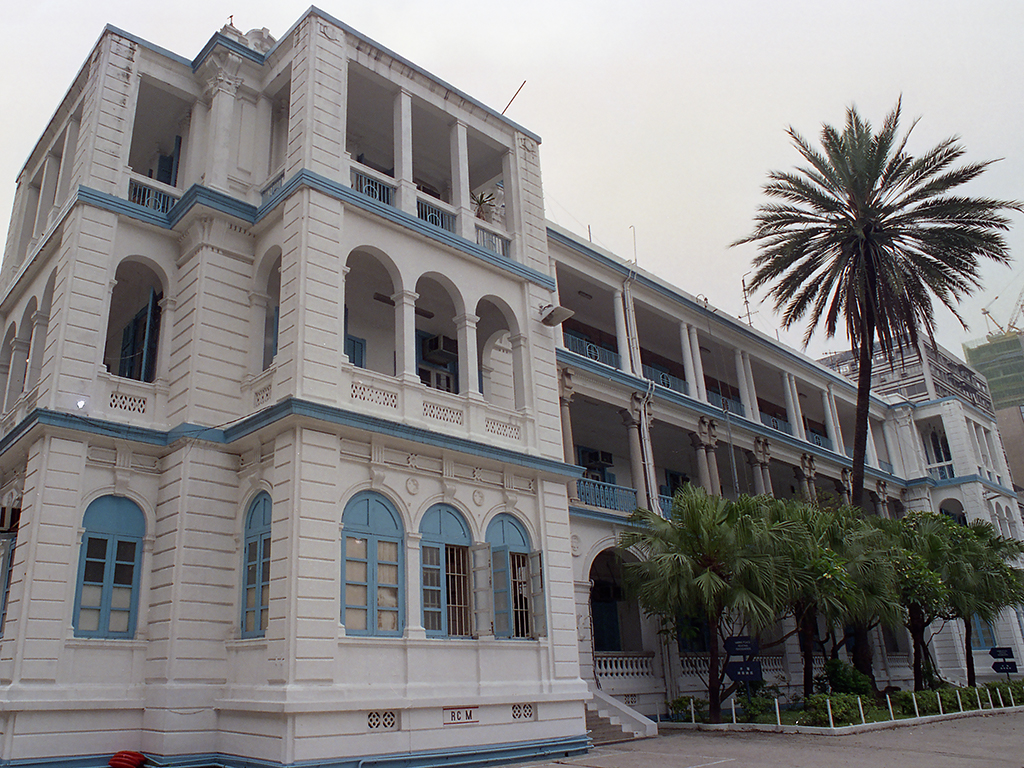
The former Marine Police Headquarters was completed in 1884. It comprised the main building, a stable block and a time ball tower. The compound can be seen as a combination of Victorian colonial design and Neoclassical architecture. The main building was occupied by the Marine Police, and the time ball tower in the front was used to provide time signals to ships passing through the harbour. In 1907, the tower ceased operation, and was moved to Blackhead Point. The Marine Police moved out from the compound in 1996, and the government approved the revitalisation project of the building to 1881 Heritage in 2003.
In the age when the technology was not well developed, mariners solely relied on the local standard time service. A reason for having the time ball tower situated in that location was due to the sea vision of this hill exceeding 200 degrees. The time ball on the top of the tower was raised manually every morning and unloaded at 1 p.m. A vessel based on the unloading time to adjust the marine chronometer to calculate its position. Mechanical devices are now installed in the tower, and the time ball displayed on the top of the tower is referenced by time balls and observatory data in different locations.
Photo courtesy of Antiquities and Monuments Office
Kowloon Wharves
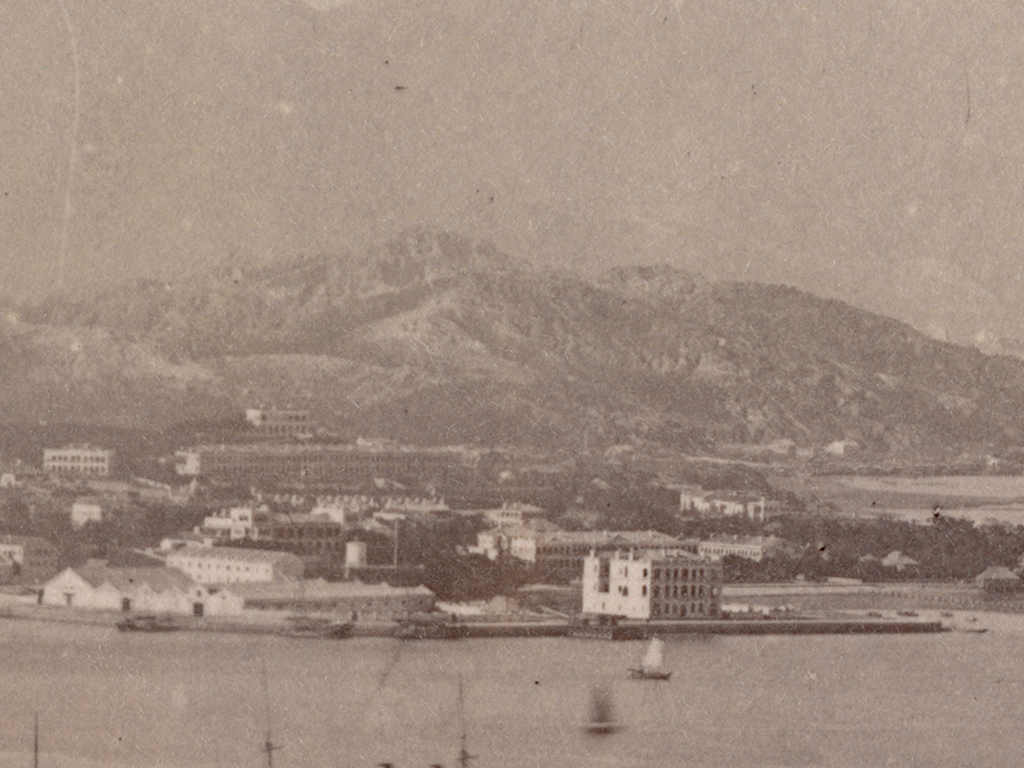
The Wharf (Holdings) was founded in 1886 – the Kowloon Wharves were jointly established by Paul Chater and Jardine Mathes for developing port terminal and warehouse facilities. The Kowloon Wharves initially had two wharves, while the main warehouse had a round-arched entrance in a Gothic architectural style. Afterwards, the group purchased another wharf warehouse in Sheung Wan and which named West wharf while the one in Tsim Sha Tsui was referred to as East wharf. Subsequently, the group also acquired a Wanchai warehouse to make up for the shortage of space at East wharf. In 1898, the company acquired the Kowloon Ferry Company and renamed it the “Star” Ferry Company. In 1980, the late Sir YK Pao acquired The Hongkong and Kowloon Wharf and Godown Company Limited (now known as The Wharf Group).
There was a saying that Kowloon Wharves’ development was inseparable to typhoons in Hong Kong. In 1874, there was a strong typhoon that forced many warehouse and terminal owners into bankruptcy, which then caused the land to be returned to the government. In 1885, the auction for the coastal area of Tsim Sha Tsui was won by Paul Chater. Due to his winning bid, this sparked the opportunity to establish Kowloon Wharves. However, the Tsim Sha Tsui wharf was destroyed by a typhoon in 1906 and was later rebuilt into a new classic-style pier.
Photo courtesy of Moonchu Foundation and the Hong Kong Museum of History
Observatory
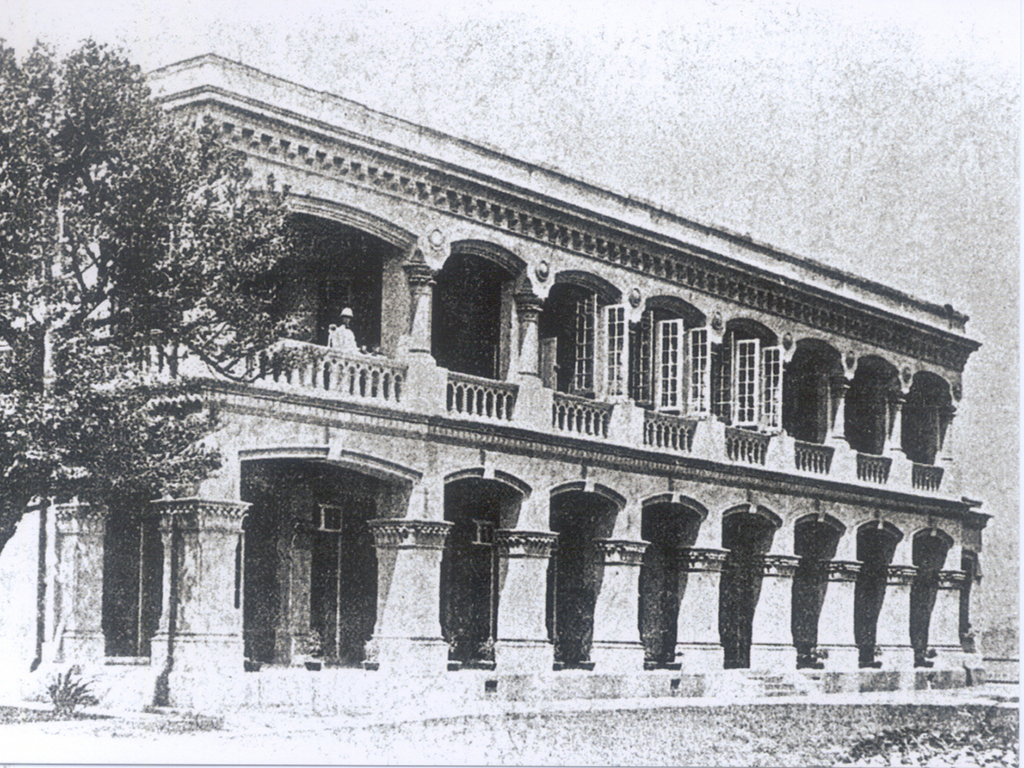
The Hong Kong Observatory publishes weather information to the public every day, yet do you know its history? The first Director of the Observatory, Dr. William Doberck, arrived in Hong Kong in 1883, the year when the Hong Kong Observatory was established. Early work included the provision of time service and carrying out meteorological observations, as well as geomagnetic measurements. The Observatory building was designed in the style of the Victorian colonial period. It had two floors with arched windows and a long corridor. Then, a new building was completed in its vicinity, and allowed the technology and functional departments to move in. The current building was declared a monument and still serves the office of the Directorates and administration division.
Dr William Doberck was the first Director of the Hong Kong Observatory with effect from 2 March 1883. On 28 July that year, Dr Doberck and his assistant Mr Frederick Figg arrived in Hong Kong, commencing the preparatory works for setting up the Observatory. Throughout the years, the Observatory gradually developed into a government department with more than 300 people. The Observatory started operating the Tropical Cyclone Warning System in 1884, initially employing signals of different shapes to give information on the location and movement of tropical cyclones to the mariners in the harbour. When a typhoon approached Hong Kong, a typhoon gun was used or explosives were ignited to give a warning of imminent gale force winds to the local public. In 1917, the first numbered signal system for the warning of local wind conditions in Hong Kong was introduced.
Photo courtesy of Hong Kong Observatory
Blackhead Point

The small hill used to be called “Blackhead Point” in the early years due to a company called Blackhead and Co. residing downhill. In 1907, the time ball tower which used to be located in front of the Marine Police Headquarters was moved to that location, and it continued to provide time service for mariners and the public since 1908. The time ball was a hollow copper ball with a diameter of six feet. It was raised by hand-winch to the top of the mast before 1 p.m. and it automatically dropped to the bottom of the mast at 1 p.m. From 1920 to 1933, the time ball scheduling was changed to twice a day at 10 a.m. and 4 p.m. The Signal Tower used flags or lights to send signals to the mariners, so people started calling the location Signal Hill.
Another name for Blackhead Point was “Tai Pau Mai (Big Rice Bag)”– this was because the hill was too small to be called a mountain. Instead, it looked like a bag of rice lying on the ground. The place was once a strategic high point for the British army with the Kowloon East Fort originally built here, and it guarded the Victoria Harbour together with the Kowloon West Fort near the former Marine Police Headquarters. The Signal Tower was requisitioned as a temporary ammunition dump during World War II, then it was abandoned for years. In 1958, the British army returned Blackhead Point to the government.
Photo courtesy of the Hong Kong Museum of History
Animation:

“Tsim Sha Tsui” emerged in history around 400 years ago, during the time of the Ming dynasty Tsim Sha Tsui means “sharp sandspit” in Chines and also describes its geographical appearance. The area was still underdeveloped, bleak, and desolate in 1900. To accommodate the development of this location as a harbour, the Government built a Time Ball Tower for mariners to keep their timepieces accurate with the ball apparatus.