Lei Yue Mun – Viewing Deck 3 1950s
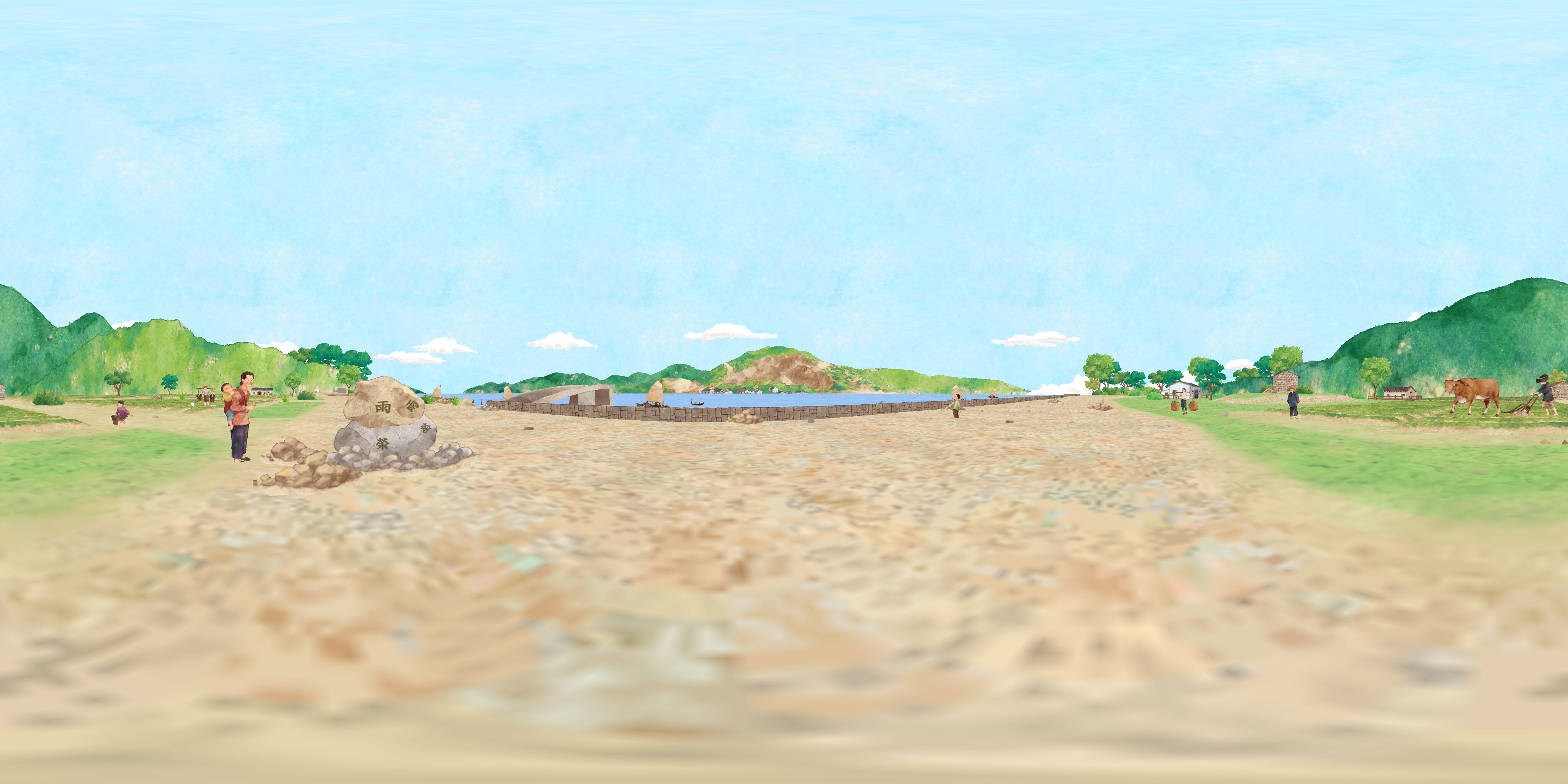
360-degree panoramic artwork created by Carmen Ng
Historical Hotspots:
The Stone Pier

This stone bridge served as an unloading pier for the surrounding quarries. In the 1950s, quarrying was the main economic activity in Lei Yue Mun. The pier made it easier and faster for workers to transport rubble stones from the quarry to the stone ships.
The stone pier was also used to berth pilot boats that carried pilots to large foreign vessels.
In Lei Yue Mun, where most of the residents were Hakka people, the pier was always known as ‘bridge’ (in Cantonese: kiu4), as this word shared the same meaning as ‘pier’ in the Hakka language. Some Lei Yue Mun residents recalled that they often climbed up the stone pier to play and even jumped into the sea from the highest point when they were small. Therefore, this stone pier is full of childhood memories of many residents.
After economic transformation of Lei Yue Mun, this pier was once a popular place for fishing in Lei Yue Mun until it collapsed in 2002. The ruins of the pier can still be seen from the left side of this lookout point.
Photo courtesy of Special Collections, The University of Hong Kong Libraries.
Lyemun Pass

Lyemun Pass is the eastern entrance to Victoria Harbour, covering both Shau Kei Wan on Hong Kong Island and Yau Tong in Kowloon East.
Lei Yue Mun has witnessed Hong Kong’s economic development since the 1950s, when Hong Kong’s economy gradually recovered from the post-war period. Southbound immigrants from the Mainland brought with them skills and capital, resulting in rapid population and economic growth. According to the statistics released by the Hong Kong Government, Hong Kong’s foreign trade exceeded HK$7.5 billion in 1950 and reached HK$9.3 billion in 1951. The demand for merchant transportation therefore increased sharply.
Lyemun Pass played an important role in the development of trade. With an approximate 43-metre depth, it allows most of the massive merchant and cargo ships to pass through Victoria Harbour.
Photo courtesy of Special Collections, The University of Hong Kong Libraries.
Sampan

Sampan, commonly known as ‘small boat’ (in Cantonese: dou6 zai2) or ‘rowing boat’ (in Cantonese: jiu4 jiu4 syun4), is a small wooden boat propelled by oars. It was the main maritime transport in Lei Yue Mun in the 1950s. When residents needed to travel to Shau Kei Wan on the opposite side or along the Kowloon Peninsula, or if they needed to board larger boats, they usually chose to travel by sampans.
As the development of Hong Kong Island had started earlier, Shau Kei Wan was better developed than Lei Yue Mun at that time, with stores selling grain and oil, fuels, and groceries. Furthermore, since there were no mail delivery services in Lei Yue Mun before 1956, Lei Yue Mun residents had to borrow the addresses of shops in Shau Kei Wan to receive their mails. The residents hence would take sampans to Shau Kei Wan every week to buy daily necessities and collect mails.
Photo courtesy of Hong Kong Heritage Museum
Animation:

Lyemun Pass is the deepest channel in Victoria Harbour. Since it can accommodate large cargo ships, steam-powered cargo ships often passed through Lyemun Pass in the 1950s. At that time, cargo ships not only exported Hong Kong-manufactured garments, shoes and plastic products to the rest of the world but also imported food and textiles from Mainland China, Japan, and the United Kingdom.