Lei Yue Mun – Viewing Deck 4 1940s
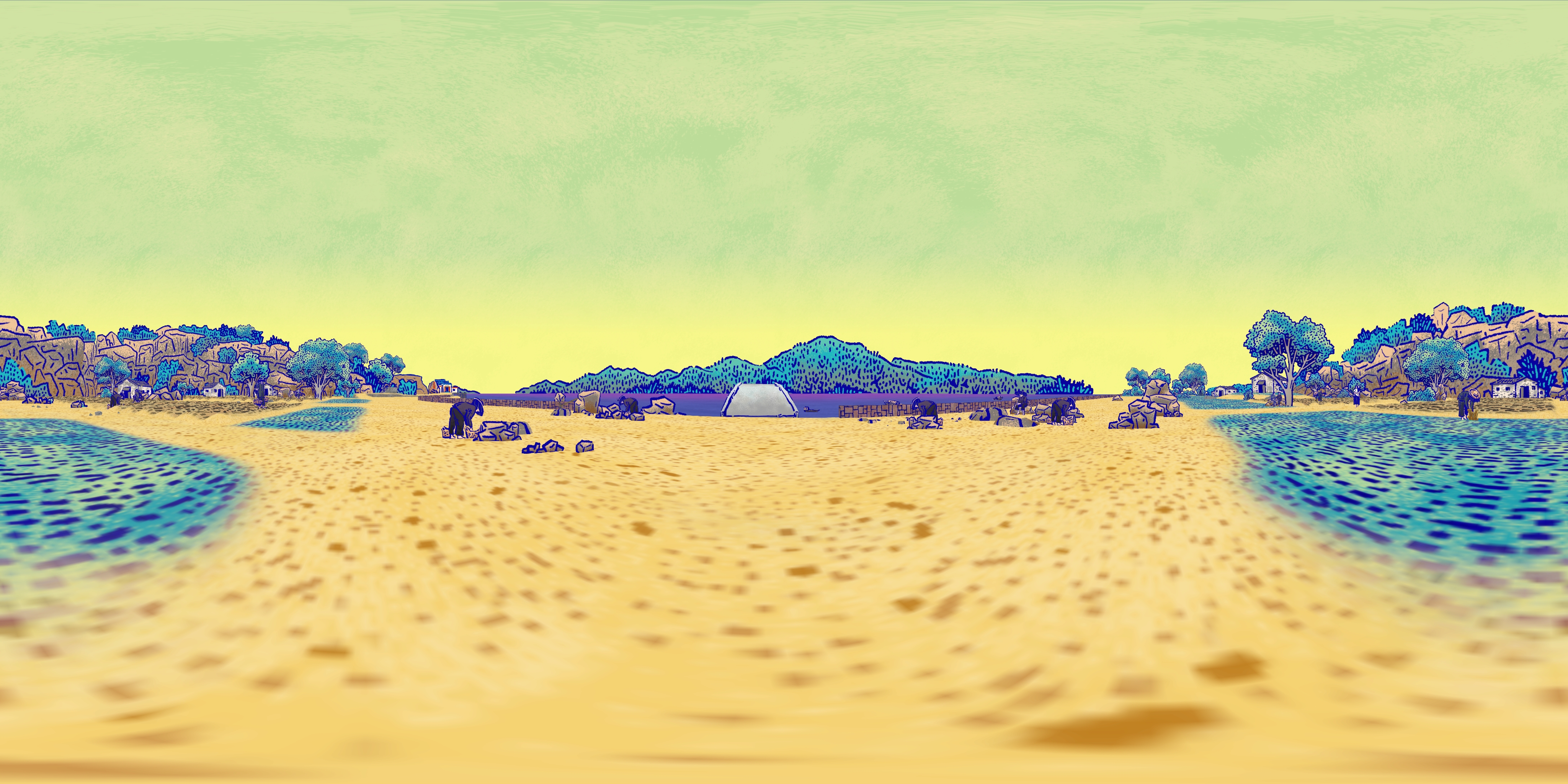
360-degree panoramic artwork created by Tony Cheng
Historical Hotspots:
Lei Hing Quarry Company
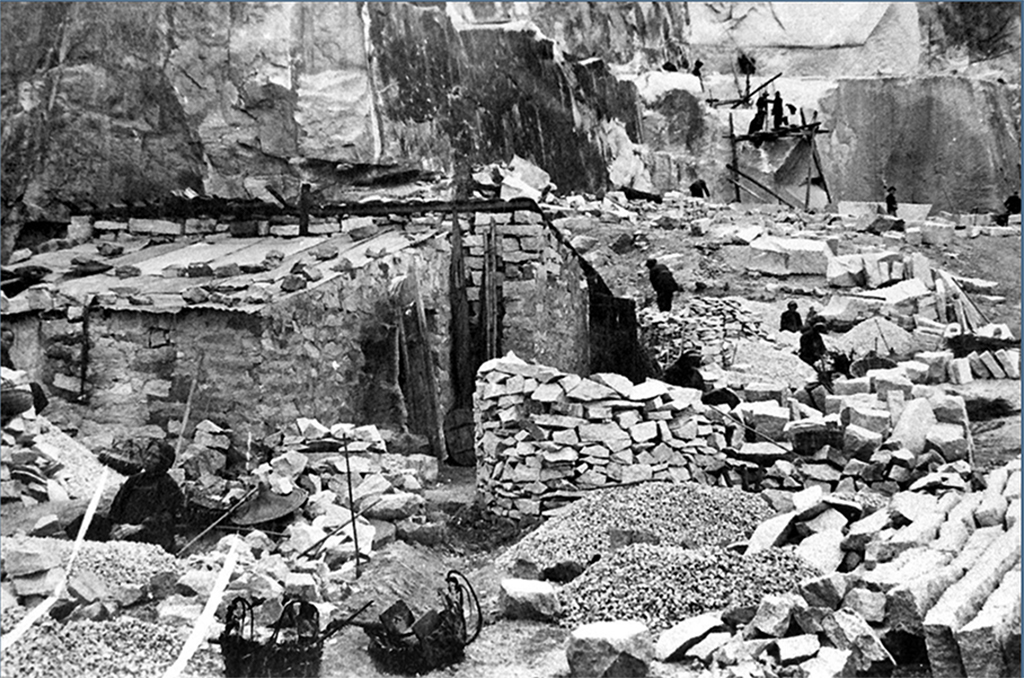
Lei Hing Quarry Company, one of the quarry companies issued with a licence in the 1940s, was once housed in the current Ma Wan Tsuen. Before World War II, quarry workers employed various hand tools to extract granite stones. By use of sharp chisels and hammers, they first dug a long hole in the granite stones on the mountain behind Lei Yue Mun village. Dynamite was then placed inside the hole, and another worker would oversee the detonation. Afterwards, the quarry workers would collect the gravel. This was a dangerous way of quarrying and accidents happened from time to time. In the 1950s, quarry workers switched to using machines for quarrying. They placed large granite stones inside a lithotripter that crushed them into smaller pieces and then sorted them by size.
The quarry workers transported granite stones to the stone bridge near the seaside (i.e. the then unloading pier) by various means. Small crushed stones were placed in bamboo baskets and carried by hand, while large stones were placed by workers on wooden boards and then hauled to the pier on a stone chute paved with gravel and sand. Besides, as the stone chute was one level higher than the main road along the seaside, workers unloaded stones from the chute to the seaside using a front dumper. When the stones were transported to the seaside, workers transported them along the stone pier to the ships which then shipped the stone away.
Photo courtesy of Mr Ko Tim Keung
Ma Wan Tsuen

Ma Wan Tsuen, formerly known as Ah Ma Wan Tsuen, has been established since the 1840s. The village was first named as Ah Ma Wan Tsuen as Hakka people called Tin Hau ‘Ah Ma’, and there was a Tin Hau Temple in the village. In the 1970s, the government renamed the streets in Lei Yue Mun, and the village was officially named as ‘Ma Wan Tsuen’. The village used to be a big piece of farmland, with just a few houses scattering around. In the late 1970s and early 1980s, many immigrants settled in Lei Yue Mun and numerous squatter huts were then erected in Ma Wan Tsuen.
Since the village was near the quarries, residents utilised the excavated stones to build houses and pave roads. These stone bricks, which were rectangular after cutting, earned the nicknames ‘dei6 ngau4’ (literal translation: earth cow) or ‘sek6 ngau4’ (literal translation: stone cow) in Cantonese. Some of these stone bricks can still be seen today, adorning the exterior walls of houses or forming the waterfront paths in Lei Yue Mun.
Photo courtesy of Jockey Club Lei Yue Mun Plus
Quarries Zone in Lei Yue Mun

Lei Yue Mun, Ngau Tau Kok, Cha Kwo Lingand Sai Tso Wan were known as the ‘Four Hills where Hakka stonemasons began quarrying as early as 1821. Before World War II, stone companies quarrying in Lei Yue Mun included Tong Li Tang, Tong Tai Tang, etc. However, all operations ceased during the Japanese occupation. In the late 1940s, after the government reissued licenses, numerous new stone companies emerged, such as Dai Hing, Wong Yin, and Lei Hing. These companies introduced modern machinery and hired plenty of workers to propel the quarrying industry to its peak.
The granite stones from the ‘Four Hills’ were renowned domestically and internationally. They were used in the construction of notable buildings, such as The Court of Final Appeals Building in Hong Kong (completed in 1912) and the Sacred Heart Cathedral in Guangzhou (completed in 1888).
In the 1960s, due to stricter government regulations on the use of explosives, no further licence renewals were granted to quarries, coupled with the hazardous nature of quarrying, the quarrying industry in Hong Kong began to decline. As a result, the quarries in Lei Yue Mun were shut down one by one in the late 1960s.
Photo courtesy of Jockey Club Lei Yue Mun Plus
Animation:

Most of the quarry workers were Hakka people, and the Hakka women who worked in quarries would wear loose black (or blue) clothes and conical bamboo hats with black yarns sewn around the edges. They used bamboo baskets to transport gravel to the pier. Since these bamboo baskets were used to carry excrement in Hakka villages, the gravel in the bamboo baskets earned the nickname ‘sek6 si2’ (literal translation: stone excrement) in Cantonese.