YAU MA TEI – Canton Road ca.1970
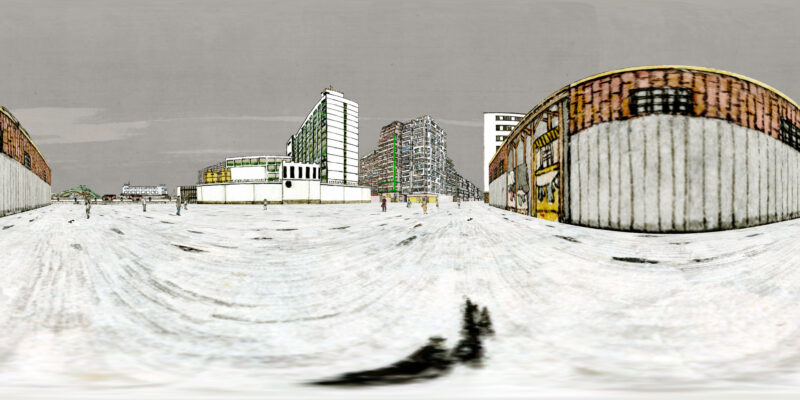
360-degree panoramic artwork created by Tang Kai Yiu, Frank
Historical Hotspots:
Man Wah Sun Chuen
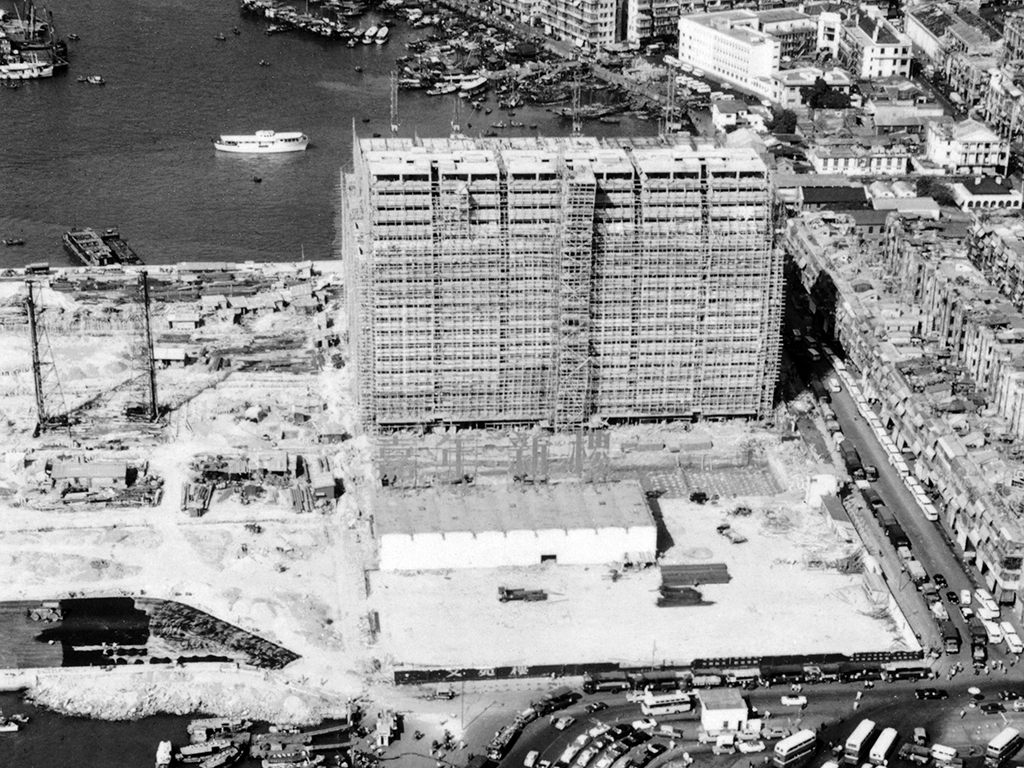
Man Wah Sun Chuen consists of 8 blocks and their names all start with the Chinese word “Man”. Hence, the compound is also called “Eight Man Buildings”. The estate was completed in phases from 1964 to 1970. Providing around 3,000 units, it was one of the largest private housing estates in early Hong Kong.
As a new housing estate at the time, Man Wah Sun Chuen was considered a decent choice for living. Not only were its three sides surrounded by the sea and space-efficient design, but also its easily accessible location. It attracted many people including celebrities such as Jackie Chan, Stephen Chow, and Sammo Hung to move into this building.
Photo courtesy of Government Photo Store, Information Services Department
Kowloon Government Dockyard
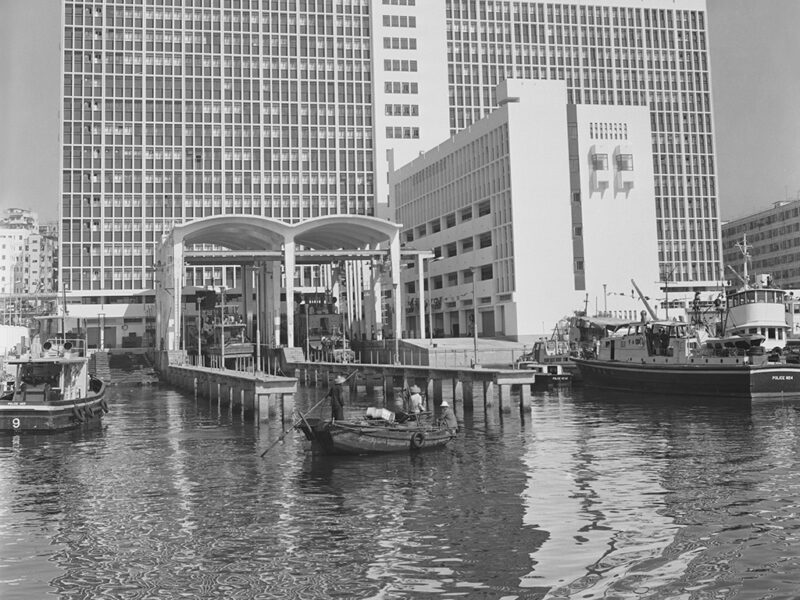
Kowloon Government Dockyard was initially named Kowloon Naval Yard, which was built with a torpedo factory by the British Army in 1934 to strengthen coastal defence. The dockyard, covering at least 680,000 square feet, was transferred from the Army to the Hong Kong Government in 1959. After the expansion of the dockyard, it was handed over to the Marine Department in 1971. Due to reclamation works in West Kowloon in 1995, the dockyard was moved to Ngong Shuen Chau (Stonecutters Island). Kowloon Government Dockyard was officially shut down after two years.
In 1996, Jordan Road Ferry Pier was relocated to Kowloon Government Dockyard as a temporary spot for its ferry route to Central due to reclamation works. It ceased operations two years later. The entire dockyard was then reclaimed and became the West Kowloon Cultural District.
Photo courtesy of Government Photo Store, Information Services Department
Jordan Road Ferry Pier

Jordan Road Ferry Pier started its operations in 1933. In addition to offering passenger ferry services, it was also the first vehicular ferry pier for cars in Kowloon. In the same year, a bus terminus was set up by the Kowloon Motor Bus Company Limited at the pier, which transformed the area into a major transportation hub on Hong Kong Island, Kowloon, and the New Territories. However, the demand for the pier began to decline after the opening of the Cross Harbour Tunnel in 1972. Eventually, the vehicular ferry service was suspended in 1994, and the pier was demolished due to reclamation works in West Kowloon two years later.
The vehicular ferry service allowed drivers to directly drive their cars onto the ferry instead of leaving their cars loaded onto the warehouse ships. Given the operation’s convenience, Jordan Road Ferry Pier was always busy. When the pier reached its peak usage from 1970 to 1971, cars were transported for over 6 million times across the harbour during the period. Ferries were classified into three distinct service categories: car, passenger with vehicle, and dangerous goods vehicle. After the cars were settled on a vehicle ferry, drivers could walk around on the ferry, purchase snacks at the kiosk, and relax while enjoying the enchanting view of Victoria Harbour.
Photo courtesy of Government Photo Store, Information Services Department
Animation:

From the 1960s to 1970s, shipping traffic was heavy in the coastal waters of Hong Kong. Other than cross-harbour ferries, the “Sampan”, a flat-bottomed Chinese wooden boat that barged the boat dwellers or ship workers to the shore, also served as a short-range vessel. Moreover, a type of electric motorboat, commonly called “Walla-Walla” (its name derived from the noise made by its loud engine), also transported people between Hong Kong Island and Kowloon. It was also known as “water taxi”.