The Peak – Lion’s Point View Pavilion ca.1900
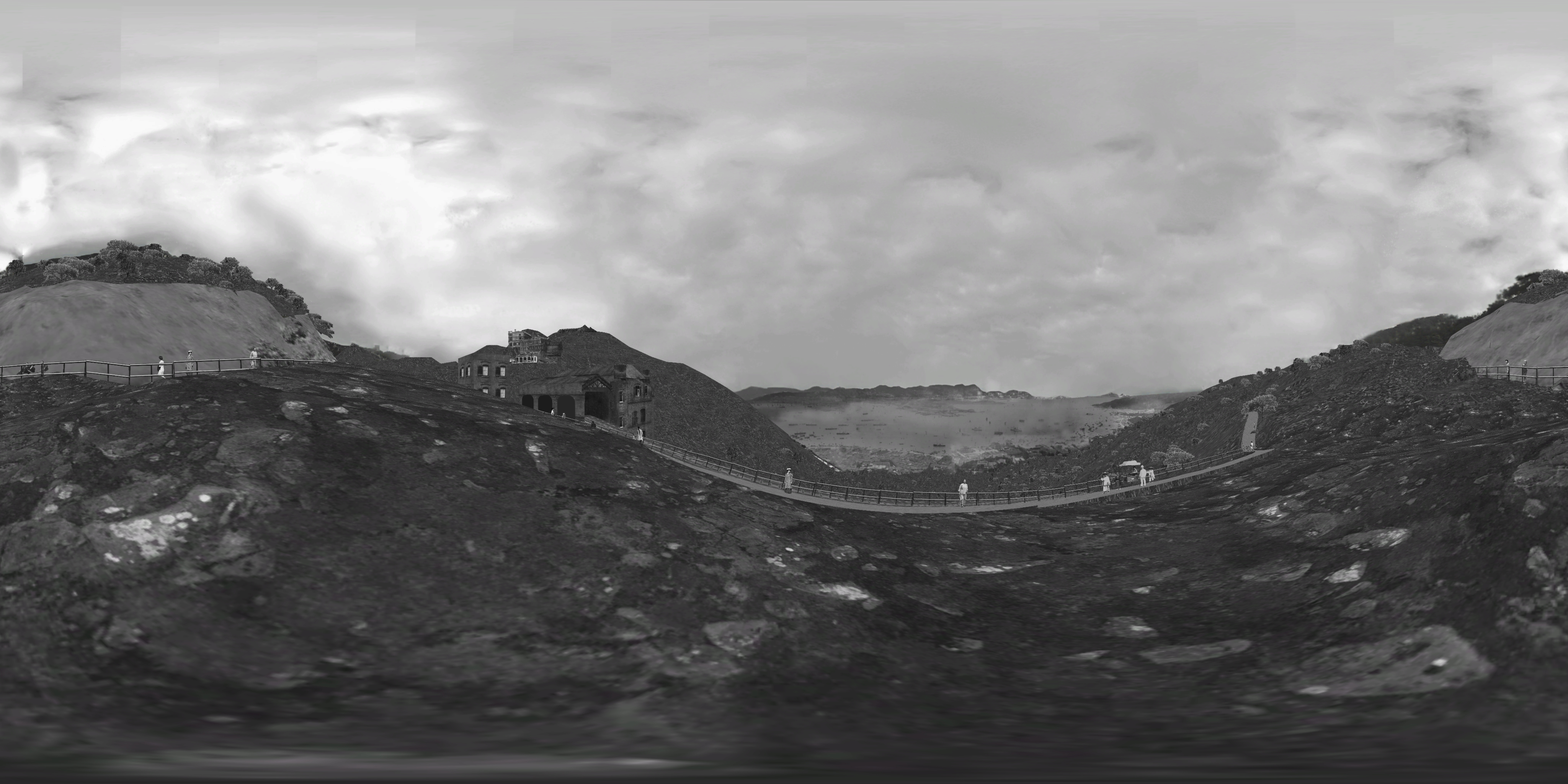
360-degree panoramic artwork developed from historical photos
Historical Hotspots:
City of Victoria

With its history dating back to 1842, the colonial government was established during the British occupation of Hong Kong Island. The government started urban development along the northern coast of the island, constructing the Queen’s Road along the coastline. Subsequently, the government further extended the development project from Wan Chai to Sai Wan (Western District) in the late nineteenth century. This area was named the “City of Victoria” at that time and alternatively called “four wans and nine yeuks” (four rings and nine districts) by the local Chinese. The “four wans” referred to Ha Wan (now Wan Chai), Central, Sheung Wan, and Sai Wan (Western District); while “yeuk” was a district sub-divided within the area of each “wan”.
In the City of Victoria, Central was the political and economic core district where European style architecture was predominantly visible. Sai Wan (Western District) and Sheung Wan were densely populated with Tong Lau, the traditional tenement buildings for local Chinese communities. Along the coastal strip of Ha Wan (now Wan Chai), it was built with upper-class housing for European residents. In 1903, the limits of the City of Victoria were declared in “The Hong Kong Gazette”, an official publication of the government of Hong Kong. Six boundary granite stones engraved with “CITY BOUNDARY 1903” were installed at different locations as physical markers, and most of the stones still remain today.
Photo courtesy of Moonchu Foundation and the Hong Kong Museum of History
The Peak Tram

A Scotsman Mr. Alexander Findlay Smith introduced his blueprint for boosting the development of the Peak in May 1881. His proposed strategy was to devise a new tram system to connect Victoria Gap with Murray Barracks. In the following year, the Hong Kong High Level Tramways Company was founded upon the approval of the government on the project. The Peak Tram was the sole means of transportation that directly carried passengers up and down between Central and the Peak, until the opening of the Old Peak Road in the 1920s.
As the first cable funicular in Asia, the Peak Tram officially commenced its public service on 30 May 1888. The railway track was constructed along the hillside, stretching 1,350 metres, and rising from 28 metres to 396 metres above sea level. Between 1908 and 1949, the two seats in the first row could not be occupied until the last two minutes before the tram’s departure because they were reserved for the Governors of Hong Kong and their ladies. A bronze plaque inscribed with “This seat is reserved for His Excellency, the Governor” was affixed to the back of the seats. Compared with the first-generation tramcar which seated 30 passengers, the fifth-generation Peak Tram accommodates up to 120 passengers per trip. Seat reservation is no longer required.
Photo courtesy of Peak Tramways Company, Limited
Animation:

The first-generation tramcar was powered by coal-fired steam boilers and its wooden carriage could carry 30 passengers every trip. On 30 May 1888, the Peak Tram system was officially put into service, serving 600 passengers on its first day. Before the 1920s, the Peak Tram was the only mode of transportation between Central and the Peak. It served over 150,000 passengers in its first year, which represented almost 80% of Hong Kong’s population at the time.